
The Quiet Agreement
Trust, Craftsmanship, and the Relationship Behind the Ink
Every tattoo begins with ink, long before that, it begins with trust. I took this photograph of Bud at Boom Boom Tattoo Room in Orange, California, while he was tattooing Kathy, a repeat client who graciously gave me permission to document the moment. At first glance, it looks like another ordinary day inside another tattoo shop. Machines humming. Flash covering the walls, a client sitting patiently while another tattoo slowly comes to life. It's a scene that repeats itself thousands of times every day around the world, which is probably why most people stop seeing what's happening. They're looking at the tattoo, and I'm looking at the relationship.
The older I get, the more convinced I become that trust is one of the rarest commodities left in modern life. We protect, question, and lose it, then spend years trying to rebuild it after someone breaks it, yet here sits another human being, voluntarily placing something permanent into someone else's hands without either of them making a big deal about it.
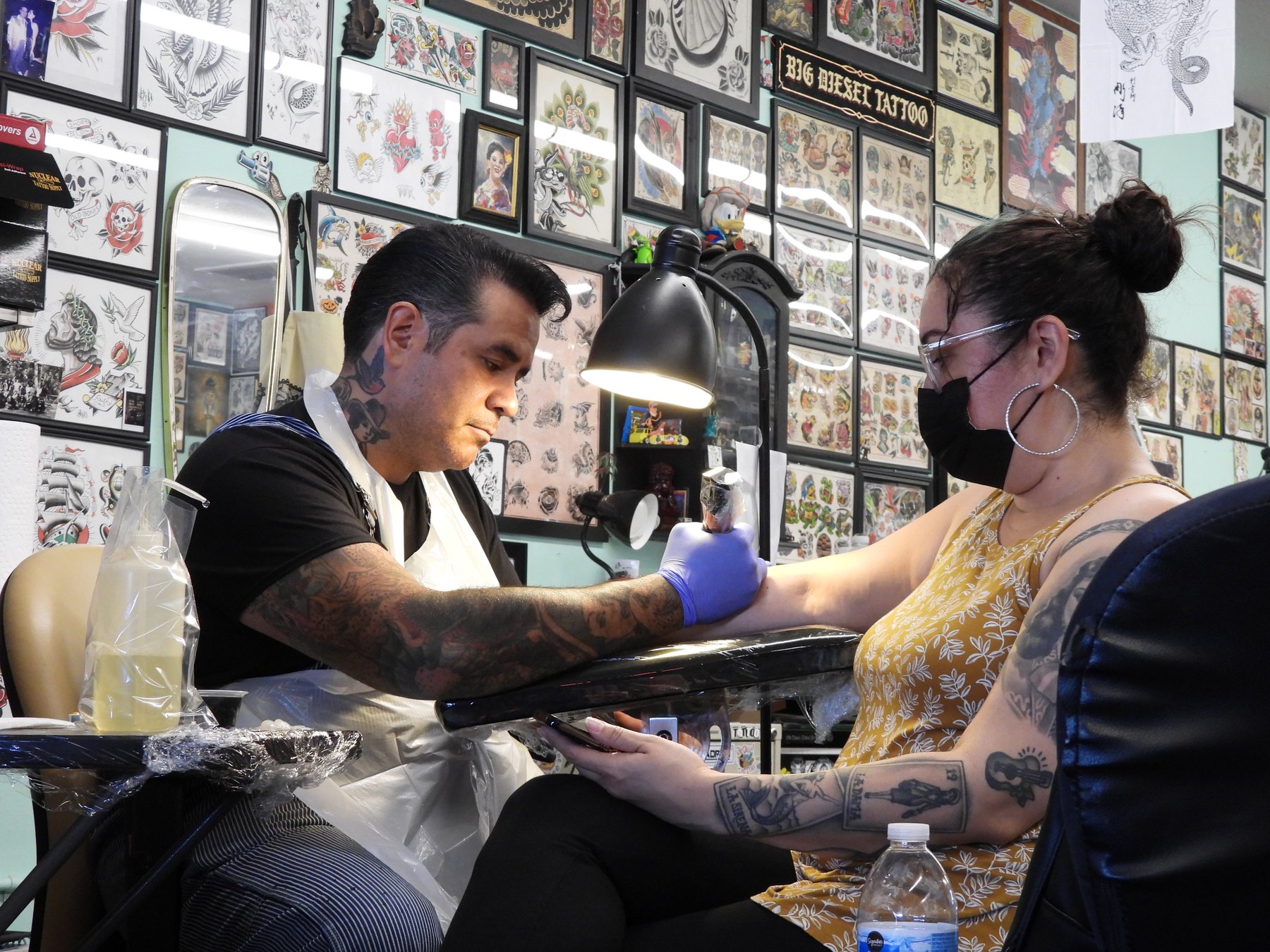
That kind of confidence doesn't appear because somebody had a good week on Instagram, or because of a flashy logo or even a clever slogan. Trust arrives much more slowly than that. It earns its way into the room one appointment at a time, one honest conversation at a time, one tattoo at a time, until one day a client stops wondering whether the artist is capable and starts wondering what they should create together next.
Everybody wants to blame the algorithm. I don't. The algorithm isn't forcing anybody to reach for their phone every fifteen minutes wondering why yesterday's reel only reached 427 people instead of 4,200. It isn't telling artists to interrupt their day because another trend just dropped or convincing them that their value somehow rises and falls with analytics on a screen. We made that bargain ourselves, and I'm beginning to wonder if it wasn't the worst trade the creative world ever accepted.
Somewhere along the line, too many artists quietly stopped asking, “How do I become better?” and started asking, “How do I become more visible?” Those are completely different questions, and they build completely different careers. One creates mastery, while the other creates dependency. Mastery has never needed permission from an algorithm. It simply waits for enough people to notice.
That's why spending time around artists like Bud leaves such an impression on me. He doesn't strike me as someone who wakes up wondering what Silicon Valley thinks about yesterday's tattoo. His attention is exactly where I think it belongs, on the human being sitting six inches away trusting him with something permanent. That's old school tattooing, and maybe that's why it has survived every trend that's come and gone over the last several decades. The algorithm may decide who gets seen today, but it has absolutely no authority over who earns enough trust that clients keep returning year after year, bringing their spouses, siblings, friends, and eventually their kids. Technology has become incredibly good at measuring attention. It still has no idea how to measure trust.
Watching Bud work reminded me that repeat clients aren't built by viral moments. They're built by ordinary moments repeated with extraordinary consistency. A good conversation. An honest opinion. A steady hand. A promise kept. A tattoo that heals exactly the way it should. Most careers aren't transformed by one spectacular day. They're built so gradually that neither the artist nor the client notices what's happening until one day someone says, “I wouldn't let anybody else tattoo me.” That's a sentence no algorithm can manufacture because it isn't earned on a screen. It's earned across years of showing up, doing the work, and treating people well after the camera is turned off.
That's the part of tattooing I don't think enough people appreciate anymore. We're living through a time where almost every profession is being encouraged to perform instead of practice. Perform for the camera, engagement, for strangers you'll never meet. Tattooing has always had performers, but the artists who seem to endure the longest usually have something else. They possess quiet confidence that comes from knowing their next opportunity isn't waiting inside a phone. It's sitting in their chair. They understand that every client isn't simply another tattoo. They're another relationship, and another chance to quietly prove that craftsmanship will always outlive hype.
Inker in time will change the way this industry thinks. We aren't standing on the outside looking in trying to figure tattooing out from hashtags and highlight reels. We're putting miles on the road, standing in shops, setting up and walking convention floors before the doors open, staying after the lights go out, and having the conversations that happen when nobody is trying to impress anyone anymore. That's where the real industry lives. Not in curated feeds, but in shared experiences, and not in chasing the next trend, but in preserving the values that tattooing built long before social media ever existed.
That's the difference. Anybody can build a platform that helps you find an artist. We're far more interested in helping you understand one. Because discovering a tattoo is easy. Discovering the person, the philosophy, the discipline, the relationships, and the culture behind that tattoo, that's where the real story begins. That's the story Inker is chasing. And that's a story worth putting miles on the odometer for.