
The Freedom to Be Misunderstood
Self Expression, Judgment, and the Courage to Be Seen
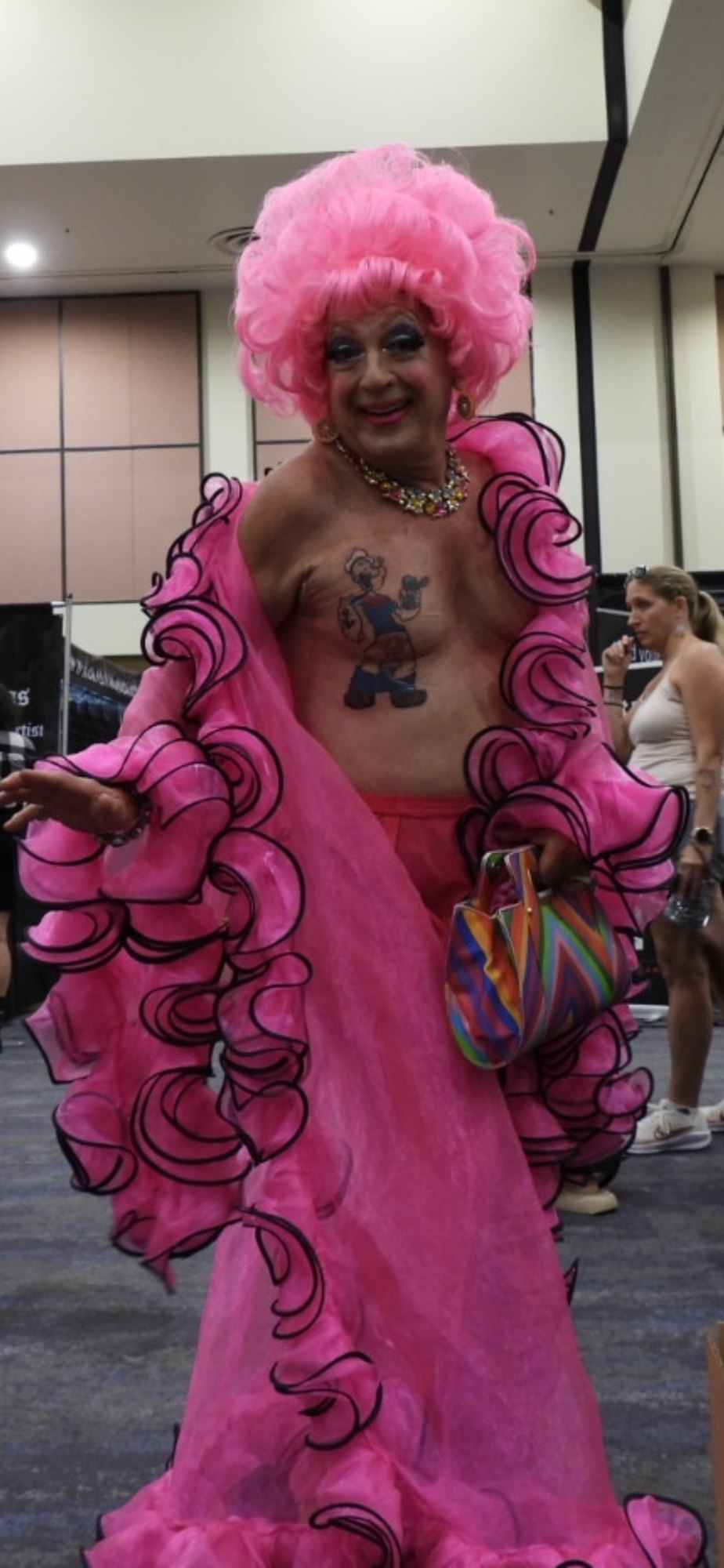
I met the gentleman in this photograph at a tattoo convention. He introduced himself as “Mis-behaven.” We spent a few minutes talking, I asked if I could take his photograph, and somewhere during our conversation he casually mentioned that his Popeye tattoo had just won first place in its category. I remember smiling because the irony hit me almost immediately. Most people walking past would never discover that part of the story. They'd stop at the pink wig, the dress, jewelry, and the makeup. Within seconds, a verdict would already be forming in their minds, and by the time they walked away, they'd probably convince themselves they had the entire person figured out. Human beings have always been remarkably efficient at reaching conclusions with embarrassingly little evidence.
That's probably why I found myself watching everyone else almost as much as I watched him. Some people smiled, laughed, pulled out their phones, and some intentionally looked the other way. Everybody had a reaction, and that reaction fascinated me because, whether they realized it or not, they weren't really reacting to him. They were reacting to the boundaries they'd quietly built around themselves. Tattoo conventions have a strange way of exposing those boundaries because they place thousands of people in the same room who have collectively decided that self-expression is worth the risk of being misunderstood. Spend enough weekends inside that world and you begin realizing that the tattoos are often the least rebellious thing about the people wearing them.
After that particular convention, my thoughts wandered in a direction only my brain seems capable of finding. I started thinking about prisons. Not the kind built from concrete, razor wire, and steel. I'm talking about the invisible ones. The prisons built from other people's expectations, worrying about being judged, chasing approval, editing ourselves until we become acceptable enough that nobody looks twice. Then I started thinking about tattoo culture and realized something that probably should have been obvious much sooner. This industry has -been filled with people who escaped those prisons long before they ever picked up a tattoo machine. The tattoos weren't the escape. They were simply the evidence that the escape had already happened.
That's what made “Mis-behaven” is so interesting to me. He wasn't standing in that convention hall asking anyone for permission to exist or conducting a social experiment. He was simply living his life with a level of comfort that most people never experience because they've spent decades negotiating with strangers they'll never meet again. The award-winning Popeye tattoo on his chest suddenly became almost secondary. It wasn't the trophy that impressed me. It was freedom.
The longer I sat with that thought, the more it started turning back on me because I realized this wasn't really about “Mis-behaven” anymore. It was about the rest of us. Most people aren't living as themselves. They're living as the version they believe will receive the fewest objections. Some hide behind tailored suits. Others behind job titles, bank accounts, confidence, or carefully constructed personalities that took years to perfect. We spend so much of our lives negotiating with other people's expectations that eventually we forget the negotiation is even happening. We call that maturity because it sounds healthier than admitting what it often is. Fear… with better tailoring.
Tattoo culture has always fascinated me because it quietly asks a question that very few industries ever dare to ask. Who would you become if you stopped negotiating with everyone else's expectations?
That's a dangerous question because it doesn't stop at tattoos. It reaches into careers, relationships, friendships, family, creativity, and every other corner of life where we've learned to edit ourselves just enough to stay comfortable. Comfort has a funny way of disguising itself as wisdom, when in reality it's often nothing more than fear that's been around long enough to sound reasonable.
I've driven a lot of miles with Inker over the past several months, and somewhere between convention and shops meeting artists from every imaginable background, one thing has become impossible for me to ignore. Tattooing isn't merely attracting people who think differently. It's giving them a place where thinking differently isn't treated as a defect that needs correcting. That's an incredibly rare thing in today's world, and I don't think the tattoo industry gets nearly enough credit for protecting that kind of freedom.
Maybe that's the real reason Inker matters. Helping people discover tattoo artists will always be part of the mission, but discovery is only the beginning. Every artist carries a lifetime of experiences that shaped the work hanging on the wall, yet those stories are too often lost between conventions, buried beneath another social media post, or forgotten as one generation quietly hands the torch to the next. The more time I spend on the road, the more convinced I become that tattoo culture deserves more than a gallery of finished tattoos. It deserves a living record of the people who built it, challenged it, protected it, and refused to compromise who they were simply because the rest of the world expected them to. That's the responsibility I believe Inker has accepted, and it's a responsibility worth taking seriously because cultures don't disappear all at once. They disappear one untold story at a time.
Dunno, maybe that's what tattooing has been trying to teach us all along. It was never about fitting in with everyone else. It was about finding the courage to stop negotiating with everyone else long enough to become yourself, and if Inker can preserve those stories while they're still being lived, it won't just help people discover remarkable artists. It'll help preserve the culture that made those artists possible.