
The Last People Holding the Thread
Tattoo Culture, Memory, and the Responsibility to Preserve What Matters
Cultures rarely disappear the way history books make us believe they do. We tend to imagine civilizations collapsing beneath invading armies, cities reduced to rubble, or catastrophes so enormous they permanently alter the course of history.
Reality is usually much quieter than that. A conversation never takes place because everyone assumes there will be another opportunity. An old tradition begins feeling less important than it did a generation earlier, and a skill that survived hundreds of years quietly reaches the last pair of hands willing to carry it without anyone recognizing the moment for what it is. Life continues exactly as it always has. Children grow up, families gather, and people go to work. The disappearance doesn't announce itself because almost nobody realizes it's happening until the people capable of explaining what was lost are no longer around to explain it.
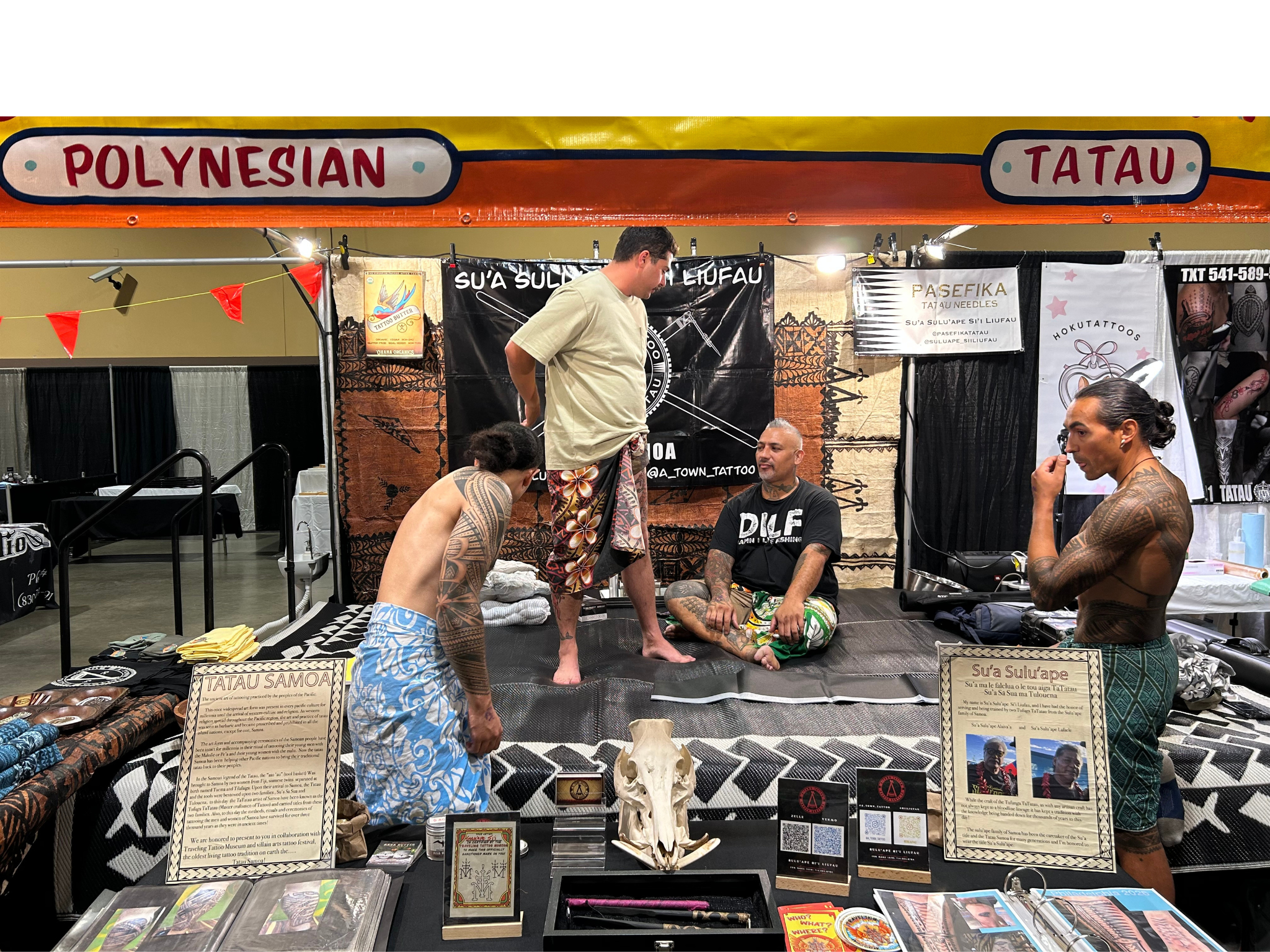
None of those thoughts were anywhere in my head when I stopped in front of a traditional Polynesian Tatau demonstration during a tattoo convention. I expected to spend a few minutes admiring another form of tattooing before wandering off toward the next booth. That's how most of us experience conventions. Everywhere you turn another remarkable artist is creating something that deserves your attention, another conversation, or a piece of artwork is pulling you in a different direction. The demonstration caught my eye because it was different, but somewhere during those first few minutes I realized the difference had very little to do with the tattoo itself. I wasn't watching artists showcase a technique. I was watching people carry something that clearly mattered far beyond the artwork being created in front of them, and that realization refused to let go of me for the rest of the day.
My brain has always worked like a human Snapple cap. Random facts, obscure history, and strange observations have a habit of floating to the surface when I least expect them, and standing there watching that demonstration, one image refused to leave me alone. The Library of Alexandria kept forcing its way into my thoughts. Historians have spent centuries debating how much knowledge disappeared with it, and the truth is nobody will ever know. We can estimate the number of scrolls, and argue over timelines, causes, and competing historical accounts, but no historian will ever calculate the discoveries that never reached another generation, the conversations that never happened afterward, or the ideas that quietly disappeared before they ever had the opportunity to shape the future. History remembers the fire because fires leave evidence. What history can never recover is everything the fire carried away.
That thought became harder to ignore the longer I stood there because Alexandria suddenly stopped feeling like an ancient tragedy preserved inside history books and started feeling like something unfolding around us every single day. We tend to imagine knowledge disappearing through spectacular events because spectacular events are easy to recognize, yet most of what humanity loses leaves so quietly that it blends into ordinary life without attracting much attention. An old tattooer spends forty years solving problems no instruction manual could ever teach, refining techniques through experience that exists nowhere except inside one lifetime, and one day those answers leave with the same hands that carried them through decades of work. A mentor spends years shaping artists without ever imagining those conversations might one day become irreplaceable. Wisdom accumulates so gradually that we begin treating it as though it will always be there, right up until the day we reach for it and discover the only person who carried it is no longer sitting across the table from us. The loss isn't measured by what we remember. It's measured by everything we'll never know we lost because nobody realized it needed protection while it was still within reach.
Looking back toward the platform, I finally understood why I couldn't bring myself to walk away. The tattoo itself had almost become secondary. What held my attention wasn't the design, the technique, or even the finished result. It was the responsibility being accepted in front of me by people who understood something I had overlooked for most of my life. Knowledge has never survived on its own. It has always depended on ordinary people making the decision that whatever was handed to them deserved another generation. Civilizations don't endure because they were stronger than everyone else. They endure because enough people quietly accepted the responsibility of carrying the thread instead of assuming somebody else would.
As I continued observing that event unfold, I couldn't shake the feeling that I had spent a good deal of time asking the wrong questions about tattooing. Like most people, I admired the craftsmanship. I noticed clean lines, saturation, creativity, and the technical discipline that separates extraordinary artists from everyone else. Those things deserve admiration because mastery deserves admiration, but standing there forced me to admit that I had been staring at the branches without paying much attention to the roots. The artwork wasn't carrying the culture. The culture was carrying the artwork. That realization completely rearranged the way I looked at what was transpiring in front of me because the people standing around that platform weren't preserving a style of tattooing. They were preserving continuity. They understood they were temporary caretakers of something that belonged just as much to generations they would never meet as it did to themselves, and there was something remarkably humbling about watching people accept that responsibility without appearing to need recognition for doing it.
The thought refused to stay inside tattooing because once your mind starts pulling on a thread like that, it has a habit of dragging everything else with it. We live during a time when documenting our lives has become almost effortless. Our phones know where we've traveled, who we've talked to, what we ate, what concerts we attended, and where we stood when we took the photograph proving we were there. Hard drives quietly collect years of our lives until we eventually run out of storage and buy more. We have become incredibly efficient at recording information, yet remarkably careless about preserving meaning. Those two ideas sound similar until you really sit with them. Information can tell me where my grandfather lived. It will never tell me why he became the man he was. A photograph can show me an old tattoo. It cannot explain the conversation that inspired it, the struggle that gave it purpose, or the mentor who quietly shaped the artist holding the machine. The facts survive, humanity quietly slips away unless another human being decides it deserves to be carried forward.
That may be the greatest misunderstanding of the digital age. Somewhere along that path we convinced ourselves that storing something is the same thing as preserving it, yet warehouses have stored books no one has opened in decades and museums are filled with artifacts whose stories disappeared long before the objects themselves arrived behind the glass. Preservation has never depended on storage. It has always depended on people who cared enough to keep asking questions, telling stories, teaching, and keep listening long after everyone else became distracted by something newer. Technology has become extraordinary at remembering data. Human beings remain the only place wisdom has ever learned how to survive and confusing those two things may become one of the most expensive mistakes our generation ever leaves behind.
That thought kept pulling me back toward Inker because helping people discover tattoo artists has always felt important, but standing there I realized discovery was never the destination. Discovery is an introduction, and introductions happen every day and are forgotten just as quickly. The conversation that follows is where memory begins. Another platform can always display another portfolio, and an algorithm can always recommend another artist whose work matches your taste. None of those things can preserve the hesitation in an artist's voice when they describe the mistake that almost convinced them to quit, the smile that appears when they remember the mentor who refused to give up on them, or the quiet conviction that only reveals itself after somebody has spent decades chasing mastery instead of attention. Those things don't belong inside an endless stream of content waiting to disappear beneath tomorrow's posts. They belong somewhere future generations can still hear them after the people speaking those words are gone.
Imagine an apprentice fifty years from now discovering an artist they admire and finding more than beautifully photographed tattoos. Imagine being able to hear that artist explain why they approached the craft the way they did, watching them demonstrate techniques that nearly disappeared with an older generation, listening to stories that would have vanished forever if nobody had taken the time to ask one more question. At that point you are no longer browsing another tattoo platform. You are sitting across the table from history while it is still capable of speaking for itself, and that is a very different responsibility from building another application or another website. That is the responsibility of making sure an industry remembers the people who built it before time quietly convinces everyone they were never there at all.
I left that demonstration thinking about something I hadn't considered before. Every generation inherits far more than it realizes. We inherit languages we never created, traditions we never started, techniques we never invented, and stories that somehow survived long enough to find us. Most of those things arrive so quietly that they feel permanent, almost as if they could never disappear, yet history tells a completely different story, and that's nothing survives on momentum forever.
At some point every generation reaches the same intersection whether it recognizes the moment or not. Carry it forward or become the place where it ends. Nobody remembers making that decision because it rarely feels like a decision at all. It feels like another ordinary day until enough ordinary days pass that what once lived naturally has become something people only read about.
The tattoo industry isn't immune to that reality. Styles will continue evolving, and machines will become more sophisticated. Artists will continue pushing technical boundaries that seem impossible today. Progress has always been part of tattooing, and I hope it never stops. The danger has never been innovation. The danger begins when innovation quietly convinces us the past no longer deserves a seat at the table. Every artist standing behind a tattoo machine today inherited far more than equipment. They inherited philosophies, discipline, techniques, hard lessons, and countless conversations that were never recorded anywhere except inside the people generous enough to pass them along. Removing those voices from the equation and tattooing doesn't lose its talent, it loses its memory, and talent without memory eventually forgets where it came from.
That's why I keep finding myself pulled back toward the same conclusion. Inker reaches much farther than helping people locate a tattoo artist or another studio. Those things matter, but they're only the front door. The room behind that door is where the real responsibility begins. Every article captures a perspective that would have otherwise lived only inside one person's memory, and conventions becomes an opportunity to preserve the personalities wandering the aisles, the mentors quietly shaping careers, the artists whose names may never become famous but whose influence will continue showing up in work created by hands they will never shake. None of that feels particularly urgent until enough years pass that the people capable of telling those stories are no longer here to tell them themselves. By then the opportunity had already moved on to another generation, leaving behind the same question history has asked humanity since the beginning. Why didn't anyone think to ask while they still could?
I don't think Inker is building a collection of artist profiles. I think it's building tomorrow's primary source material. Long after today's social media platforms have been redesigned, renamed, replaced, or forgotten, there will still be artists searching for the people who shaped the industry they inherited. They'll want to understand the personalities and want to know what those artists believed when nobody was asking them for content, what they feared before anyone knew their name, or refused to compromise, what made them laugh, broke their hearts, what kept them moving after failure, and why they dedicated their lives to an art form demanding more from them than most professions ever could. That's the kind of history no algorithm has ever cared enough to preserve, yet it's the history people inevitably search for once enough time has passed.
Standing in front of that Polynesian Tatau demonstration, I thought I was watching tattooing. Somewhere between the first strike of that traditional tool and the last, it became impossible to ignore that I was really watching people carry memories across generations, accepting a responsibility they never asked for but willingly embraced anyway. The tattoo was never the destination; it was the vessel. The ink carried something invisible that couldn't be framed, photographed, or displayed inside a convention booth because the most valuable thing being preserved wasn't resting on the skin. It was moving quietly from one human being to another with the hope that somebody further down the line would continue carrying it after they were gone.
Years from now those tattoos will still exist. What I'm hoping for is that the voices behind them will still be there too, patiently waiting for somebody curious enough to press play, because a culture is never remembered for what it created alone. It's remembered for what it cared for enough to preserve.