
The Guy Behind the Fox Tail
The People Who Keep Tattoo Conventions Moving
I can walk into a tattoo convention surrounded by artists whose work deserves every bit of attention it's getting and somehow leave obsessed with something that has absolutely nothing to do with tattooing. That little quirk has followed me for as long as I can remember, and after fighting it for years I finally quit arguing with it because the things refusing to leave me alone usually know something I don't. Curiosity doesn't arrive with a map. It grabs hold of something that doesn't fit, refuses to let go, and waits to see if I'll keep pulling on the thread long enough to discover what it's connected to.
An electric tricycle with a giant fox tail happened to be that thread. It rolled past me the first time and I laughed to myself. It rolled past again and I smiled because I still couldn't make sense of it. By the time it crossed my path again the tricycle wasn't really what I was looking at anymore. My attention had already moved behind the handlebars where the same person kept appearing in completely different parts of the building, never staying anywhere long enough to become part of the scenery before another conversation, another question, or another responsibility pulled him somewhere else. The fox tail had become background noise. The person riding in front of it hadn't.
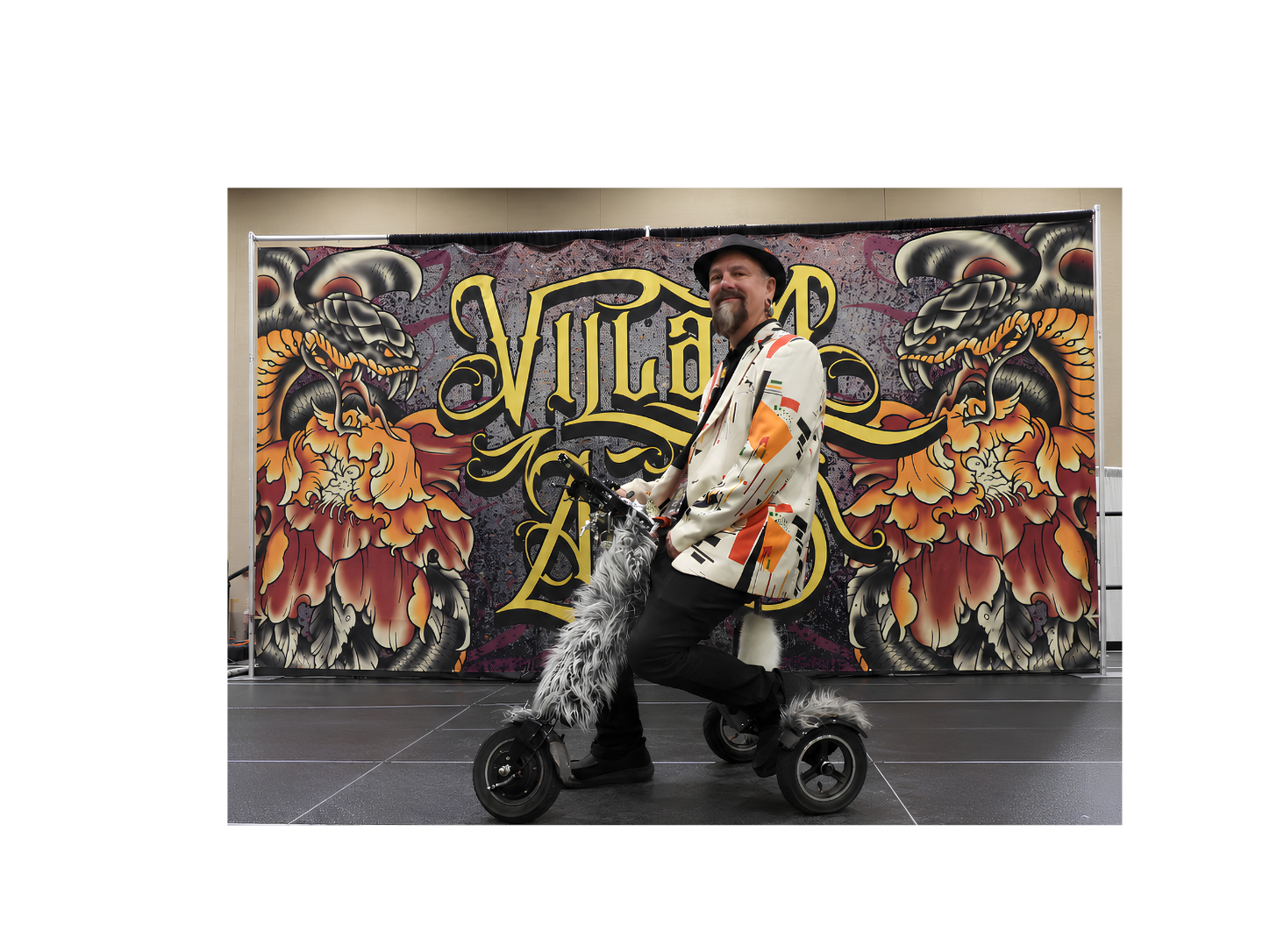
His name is Troy Timpel. We spoke briefly, although “met” is probably a better word because conversations and introductions aren't necessarily the same thing. You can learn somebody's name, shake their hand, exchange a few words, and walk away knowing almost nothing that actually matters. Names are easy, but understanding another human being has always demanded something completely different, and that isn't the kind of thing you squeeze into a few minutes while dozens of other people are trying to borrow the same person's attention.
Troy never looked busy in the way busy people usually look busy. There wasn't any rushing around or theatrical urgency. He just kept moving. A vendor needed him here, a question pulled him somewhere there. A conversation ended and another one had already started somewhere across the room before anyone had time to notice he was gone. Watching that pattern repeat itself changed the way I looked at the tricycle because it finally stopped looking unusual. It looked practical. Cover enough ground in a convention hall and walking starts losing the argument.
That wasn't the story, it was the doorway. The tricycle slowly became the least interesting part of what I was watching. Troy kept turning up in places that didn't seem connected until I stopped thinking about where he was going and started paying attention to what happened after he arrived. A question disappeared; somebody smiled and went back to work. Another conversation ended, another problem was presented which never had the chance to become a real problem at all.
None of it attracted a crowd, and I doubt it was supposed to. The work wasn't designed to be noticed. It was designed to keep everything else moving without interruption, which is a strange kind of success when you think about it because the better someone becomes at that job, the less anyone realizes they're doing it.
That pattern followed me around the rest of the convention. I never saw anyone stop Troy to congratulate him for keeping things running smoothly. Nobody gathered around asking for photographs or waiting to hear his opinion on tattooing. What kept pulling at me was everything happening around that work, the machinery nobody could see because it wasn't made out of gears or steel. It was made out of people solving one small problem after another until an entire room full of strangers could spend the day thinking about tattoos instead of logistics.
It's funny how quickly we accept a smooth experience as something that just happened. Walk into a convention where everything works and the thought never crosses your mind. Walk into one where nothing works and it becomes the only thing anybody talks about. Success has an unusual habit of disappearing into the background. Failure rarely extends the same courtesy. That observation stayed with me long after I stopped watching Troy because I couldn't shake the feeling that I had stumbled onto something much bigger than one convention.
Tattooing produces remarkable artists. Nobody needs me to tell them that. Spend a few minutes looking around and the evidence is hanging on people's arms, backs, legs, and hands. What interests me just as much are the people whose fingerprints end up on the industry without ever appearing inside the frame. They're the ones creating opportunities, introducing artists who would've never met, solving problems nobody else even knew existed, and building the kind of foundation that quietly allows everyone else to chase what they love.
Those people don't usually become the story, but that doesn't mean they aren't shaping it. Troy agreed to a remote interview before we headed in different directions, and that mattered for a reason I didn't completely understand until I started driving home. Watching somebody work only tells part of the story. Work shows you habits. Conversation shows you convictions. The two don't always point in the same direction, and that's exactly what keeps me chasing interviews instead of photographs. A photograph freezes one moment. A conversation gives another human being enough room to explain how hundreds of moments slowly became a life.
That's the space I keep seeing Inker move toward, and I don't think it has much to do with technology. Technology changes every few years. Somebody builds something faster, cleaner, cheaper, or more convenient, and the cycle starts all over again. Conversations don't follow those rules. Once they're gone, they're gone. There isn't an update waiting next month, or a backup hiding somewhere nobody remembered to check. A voice disappears, and with it goes a way of thinking that never existed anywhere except inside the person who carried it.
That responsibility feels bigger than artist profiles or another collection of beautiful portfolios. Tattooing already knows how to preserve remarkable artwork. The people behind that artwork deserve the same commitment. A machine can tell you what somebody created, but it can't tell you what failure taught them, why they refused to compromise, or what they hope survives after they're gone. Those answers only exist while somebody is still here to answer them, which makes the window surprisingly small when you really think about it. None of us knows which conversation becomes the last opportunity to ask the question that would've mattered twenty years from now.
That's the part that keeps bringing me back to the road. Every convention puts another group of artists, shop owners, promoters, and old friends in the same building for a few days before life scatters everyone back across the country. Those conversations are happening whether anyone records them or not. The difference is whether somebody decides they're worth carrying forward before they disappear into memory like thousands of conversations already have.
The remote interview with Troy will happen when the convention noise has been replaced by something much more useful. Time. There won't be another responsibility waiting across the room or another question pulling him away after thirty seconds. It'll just be two people talking, and I've learned those are usually the conversations where the real story finally decides to introduce itself. The fox tail got my attention. Curiosity kept me standing there. The interview is where I'll find out whether my curiosity was pointing at the right thing all along.