
Tattoo Shopping?
How AR Lets You Try the Future Before It Leaves a Mark
Thinking about getting another tattoo but have absolutely no idea what you want, or perhaps you know the general direction, have saved a pile of pictures, deleted half of them, stared at your arm in the mirror trying to picture what would actually look right there, and reached the dangerous stage where every decent tattoo you see starts looking like something you could probably make room for?
Welcome to tattoo shopping, except this time you can play around with the merchandise without having to explain a questionable decision to a laser-removal technician five years from now.
Inker recently rolled out a feature that takes an interesting swing at a problem tattooing has carried for a very long time: you can upload a photograph of yourself, start experimenting with tattoo ideas through its new AR feature, and see an image of yourself sporting the tattoo before your skin has been committed to anything. What makes the feature considerably more interesting than pasting a flat design across a photograph is its ability to account for the curvature of the body, since arms taper, shoulders roll, legs bend and torsos refuse to behave like sheets of paper.
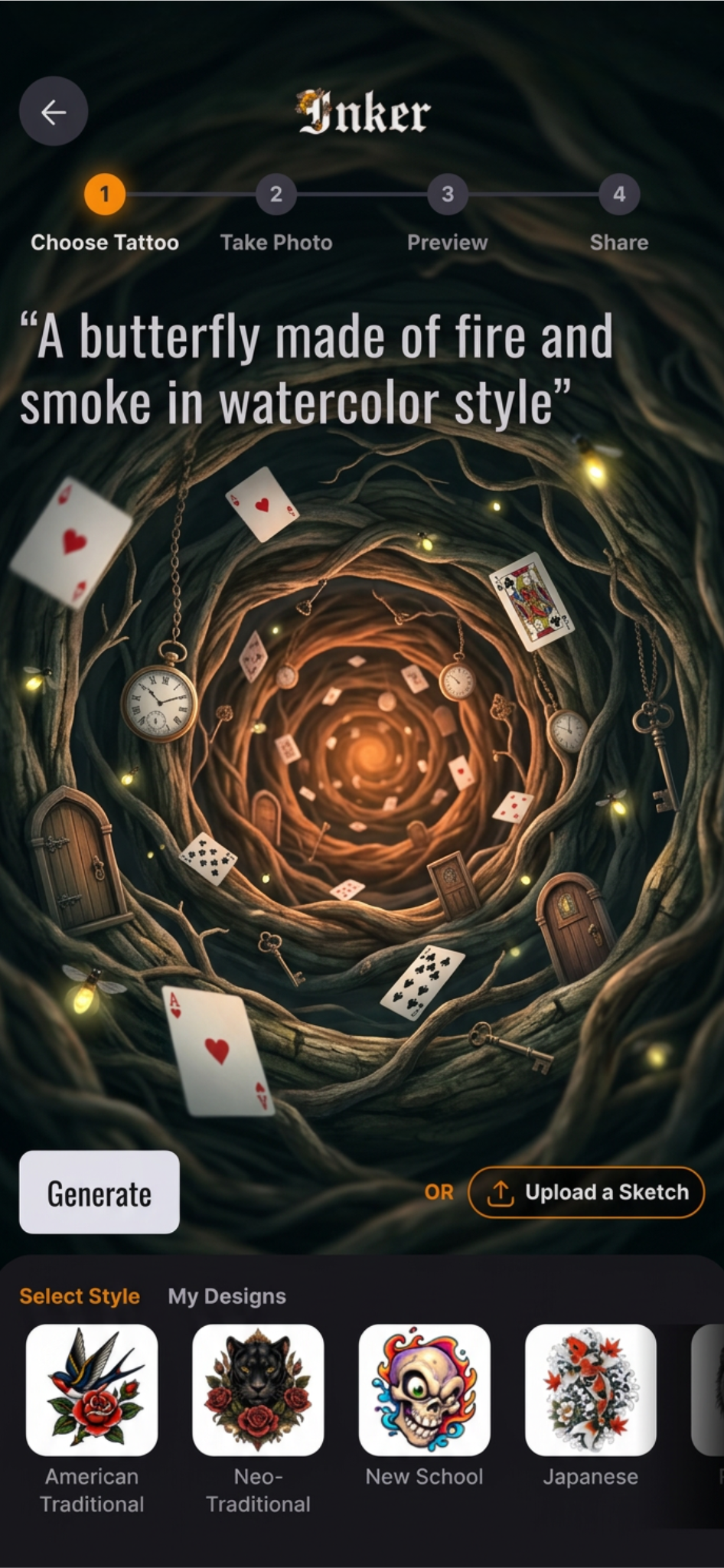
You can experiment with an idea, change direction, generate something different and get a visual reference for something you previously had to construct largely inside your head, all before making an appointment with an artist.
It's useful, fun, and I could spend the rest of this article explaining all the different ways you could use it to shop for your next tattoo, which would probably make this a perfectly respectable article about Inker's newest feature.
HOLD ON!!!!!
I want to screw this article up for a minute by asking a question that appears to have absolutely nothing to do with tattoos, AR, Inker or deciding what the “F” you want permanently attached to your body: Does code have weight?
Seriously, if I put an empty storage device on an impossibly precise scale, fill it with code and put it back on that scale, did I actually add anything to it? My first instinct was that the answer had to be yes, since we talk about digital information as though it were stuff all the time; we store it, move it, buy additional storage when we accumulate too much of it, build enormous facilities full of machines to hold it and delete files from our phones so a little graphic can congratulate us for getting our space back.
Everything about the language surrounding information makes it sound as though we are moving invisible boxes around inside our devices, which sent me looking for an answer that physics had absolutely no obligation to make convenient for this article.
Code does not possess a universal physical weight, so there is no legitimate conversion where a gigabyte equals some microscopic fraction of a gram and your phone gains a predictable amount of mass every time you download another app. Information stored in a computer still has to be represented through physical states inside actual hardware, which puts our supposedly weightless digital universe firmly inside the physical world. Physicist Rolf Landauer established the principle that information is physical and connected information processing with thermodynamics, including a theoretical minimum energy cost associated with erasing information, and Einstein gave us the much more familiar relationship between energy and mass through E=mc². None of this allows me to tell you how many pounds your Spotify library weighs, which is unfortunate since I really wanted that sentence, but it leaves us with a far more interesting question than the one I started with.
Code doesn't need measurable weight of its own to move things that do.
Numbers represented inside computers can transfer millions of dollars between banks, software can direct machinery capable of cutting steel, and instructions represented through microscopic physical states can produce consequences enormous enough to make the weight of the instructions themselves feel almost irrelevant. We built an entire digital civilization around information that cannot be placed independently on a bathroom scale, yet much of what happens in our physical lives is already being directed, altered or decided through it.
Bring that back to the tattoo Inker generated across your arm and things get a little strange, since there is no pigment under your skin, nothing has punctured it and the arm you're looking at remains exactly as it was before you uploaded the photograph. The tattoo exists on a screen, although calling it a picture doesn't quite describe what your brain is being asked to process.
A drawing of a tattoo is easy to separate from yourself; this has your arm and skin around it, your proportions determining how it sits and the curvature of your body changing its shape. You aren't being asked to picture what the tattoo could look like anymore. You're being shown evidence from a future that hasn't happened.
People love doing this to themselves. They build architectural models before pouring concrete, put pilots inside simulators before trusting them with airplanes and smash perfectly good cars into walls to learn what could happen to the people sitting inside them. They rehearse weddings, fire drills, speeches and emergencies, constantly building versions of events ahead of the real event in an attempt to steal information from the future before paying whatever price comes with getting there.
Tattooing has never given us much room for that trick. An artist can draw the design, size it, position a stencil and give you every advantage experience provides, but there remains a brutally clear dividing line between seeing what might go onto your body and looking down after the skin has actually been changed.
Now consider the absurdity of what Inker has slipped into that space. The company didn't invent our desire to peek around the corner before making a decision; it gave that old human habit somewhere new to go. Upload your photograph, generate an idea and the software builds a version of an outcome before the outcome exists, including the way the design follows the shape of the body instead of floating across it like a decal. The strange part isn't that a computer can put a tattoo on your photograph. Computers have been manipulating photographs forever. The strange part is how quickly the photograph stops feeling like the important part once the body staring back belongs to you.
There is another part of this I doubt anybody was thinking about when the feature was being built. Inker exists to connect people with tattoo artists, which sounds straightforward until you consider what has to happen before anybody needs that connection in the first place. You need the desire to get tattooed, an idea worth pursuing and enough confidence in that idea to hand your skin over to an artist. Finding the artist comes after all of that. Now the same platform that can help you find the person who might put the tattoo on you can show you a version of yourself wearing it before you've decided whether you want it. Code has managed to get itself involved on both sides of a decision that still ends with a person putting ink into another person's skin.
I think I'd abuse the fook out of this feature before settling on anything, and I suspect plenty of people will do the same, since there is something appealing about being reckless where the consequences can still be erased with your thumb. Put something enormous across your chest, try the design you have been debating for two years or generate something completely absurd just to see what your reaction is when your own face appears above it.
Somewhere inside all that screwing around there may be an image that makes you stop screwing around, and nothing about the photograph has physically changed when that happens. The phone weighs what it weighed before, your skin is untouched and the tattoo exists only as information being displayed on a screen, yet the decision that follows can send you looking through Inker for an artist capable of turning that image into the real thing.
That may be the part worth paying attention to long after the novelty of putting fake tattoos on photographs wears off. We spend an incredible amount of our lives trying to see around corners, rehearsing outcomes in our heads before making decisions we can't easily reverse, and technology keeps getting better at giving those private rehearsals something we can actually look at. Tattooing happens to make the stakes wonderfully obvious, since there aren't many places where the distance between an idea and its consequence can be measured directly on the human body.
You could close Inker, delete the generated photograph and wipe every trace of that tattoo from your phone without removing a single thing from the physical world. A week later you could be sitting across from an artist showing them the image that started the conversation, and months or decades after the file itself is gone, the tattoo could still be riding around on your arm.
The code that put the tattoo on your photograph has no universal measurable weight, yet it can send you to an artist, put you in a chair and influence what gets carried beneath your skin for decades, long after the photograph that started it has been deleted and forgotten.
There is something crazy about all of this in a good way when you consider where we started. We built code to help us picture something that doesn't exist, gave it the ability to wrap that idea around the shape of a human body, and somewhere between the pixels and the skin it acquired enough influence to help make a permanent decision.
Perhaps code never needed weight. It just needed somewhere to leave a mark.