
The Person You Keep Pretending to Be
Masks, Identity, and the Patterns We Protect
There comes a point where the mask stops feeling like a mask. It becomes your introduction, reputation, the version of yourself that people expect every time you walk into a room. It earns compliments, attracts opportunities, and convinces everyone around you that you've got life figured out. Somewhere along the way, the performance becomes so familiar that even the person wearing it begins to forget where the act ends and the real person begins.
That is where things become dangerous, as most people assume pretending is about deceiving someone else. I don't think that's true. The greatest deception usually happens internally because the human mind is remarkably skilled at protecting the stories it wants to believe. Every compromise gets justified, while contradiction gets explained away. Every missed opportunity gets blamed on timing instead of fear. Slowly, almost invisibly, maintaining the image becomes more important than confronting the reality behind it. The mask no longer exists to fool the world, but to protect the person wearing it.
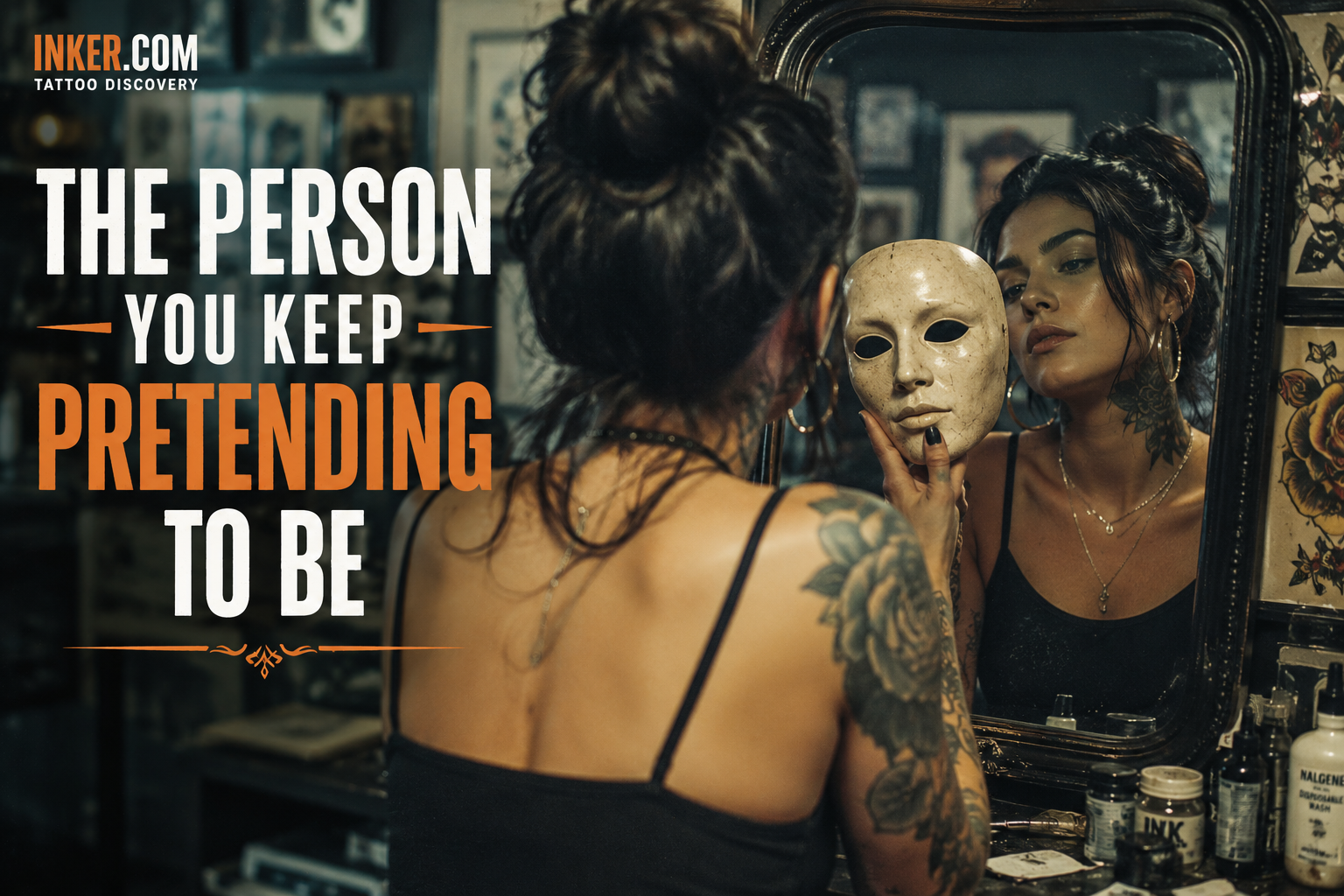
The strange part is that masks rarely begin with bad intentions. The quiet kid learns to project confidence, and the entrepreneur speaks with certainty while wearing his Patagonia vest because customers expect leadership. The tattoo artists walking into a tattoo convention carries themselves like they belong among the industry's best because nobody wants to appear uncertain in a room filled with elite talent. One quick visual to the tattoo convention mention…… The last Tattoo convention I covered a few weeks ago, some of the artists arriving acted like wrestlers entering an arena, lol. It was great!!! Ok, getting back into character. So, in the beginning, confidence can be healthy. Sometimes we must grow into the person we hope to become. The problem isn't wearing the mask for a while but forgetting to EVER take it off.
Life has a funny way of rewarding appearances, at least in the short term. People compliment what they can see. They don't see the anxiety hidden behind confidence, the loneliness buried beneath popularity, or the exhaustion that comes from protecting an identity every hour of every day. Success built on performance can quietly become its own prison because every compliment reinforces the illusion. The better the mask works, the harder it becomes to abandon.
Maybe that's why some people eventually sabotage the very lives they spent years building. From the outside it makes no sense. Why would someone destroy a successful career, walk away from a relationship, or throw away an opportunity most people would fight to have? Sometimes the answer has very little to do with the opportunity itself. Sometimes they're simply tired. Carrying a version of yourself that never allows weakness, uncertainty, or honesty eventually becomes heavier than failure itself. Losing everything can begin to feel easier than admitting you've been hiding behind a carefully constructed costume.
The irony is that most people would probably accept the real version of us far more than we imagine. Authenticity has a way of disarming people because everyone is carrying something they hope nobody notices. The difference is that some spend their entire lives maintaining the disguise while others eventually decide the weight isn't worth carrying anymore. One path requires constant maintenance, and the other offers something infinitely more valuable: freedom.
Ryan Ashley, one of the most respected artists in modern tattooing, once said, “The person you keep pretending to be.” It isn't a long quote, yet it carries the kind of weight that lingers because almost everyone recognizes themselves somewhere inside it. Every one of us has worn a mask at one point or another. Some wear it to be accepted, and to survive. But many eventually forget they ever put it on.
I don't trust conclusions nearly as much as I trust patterns. Patterns don't care about opinions, trends, or whatever happens to be fashionable this week. They quietly repeat themselves until someone is willing to notice them. After spending time inside tattoo shops, walking convention floors across the country, and sitting down with artists whose lives couldn't be more different from one another, I keep arriving at the same realization. The stories are always unique, but not the people. Hear me out…… If you strip away the different backgrounds, cities, and styles of tattooing, the same human struggles continue to surface. We build masks, and we protect them. Eventually, every one of us reaches a crossroads where we must decide whether we're going to spend the rest of our lives maintaining the image or finally discover who we are without it.
That is the journey I hope to continue exploring through my work with Inker. Tattooing may be the canvas, but human behavior is the masterpiece hiding underneath it. Every interview, every convention, every late-night conversation with an artist has reinforced the same belief: if you pay close enough attention, people reveal far more through their patterns than they ever do through their words. My goal has never been to tell readers what to think. It has been to document what repeatedly reveals itself and let the evidence speak for itself.
The tattoo industry has become my window into something much larger. Every artist I meet carries a different story, yet the emotions beneath those stories are remarkably familiar. Fear, hope, regret, reinvention, and identity. Those aren't tattoo stories, they're human stories. The more miles I put behind me and the more conversations I have, the more convinced I become that the greatest discoveries aren't found by chasing extraordinary people, they're found by recognizing the extraordinary patterns hidden inside ordinary lives.
If these observations challenge the way you see yourself, then they've accomplished exactly what they were meant to do. Not because they're my opinions, but because human nature has a remarkable habit of leaving the same fingerprints wherever you're willing to look. All I've done is slow down long enough to notice them. My hope is that, through Inker, you'll begin noticing them too.