
The Clean Ink Revolution
How Better Pigments Quietly Changed Tattooing
Occasionally, I stumble across something that reminds me just how much tattooing has changed, and this time it wasn't a tattoo machine or some artist pulling off photorealism that looks like it belongs in the Louvre, which I look forward to visiting in the future.
Ok…… It was a bottle of ink! I know, and I'll be the first to admit I've done some questionable things over the years in the name of curiosity. Somewhere on my body is a little UV tattoo, a small star that only shows up under a black light. At the time I thought it was the coolest thing ever. Walk into a nightclub, a concert, or some dive bar with black lights and, out of nowhere, there it was. Every single time I'd completely forgotten I even had it until someone would point at my arm and I'd think, “Oh yeah… I did that dumb shit!”
Years later I started reading about some of those early fluorescent inks and realized they weren't exactly famous for having the cleanest ingredient lists. Let's just say if I had today's information back then, I probably would've made a different decision. Thankfully the little star hasn't caused me any problems, but it reminds me of a time when tattooing was still figuring out a lot of this stuff.
That tiny star is like a timestamp from another era. People assume tattoo ink has always been the same. Black is black, red is red. Pour it into an ink cap and get to work. Right?! Not even close.
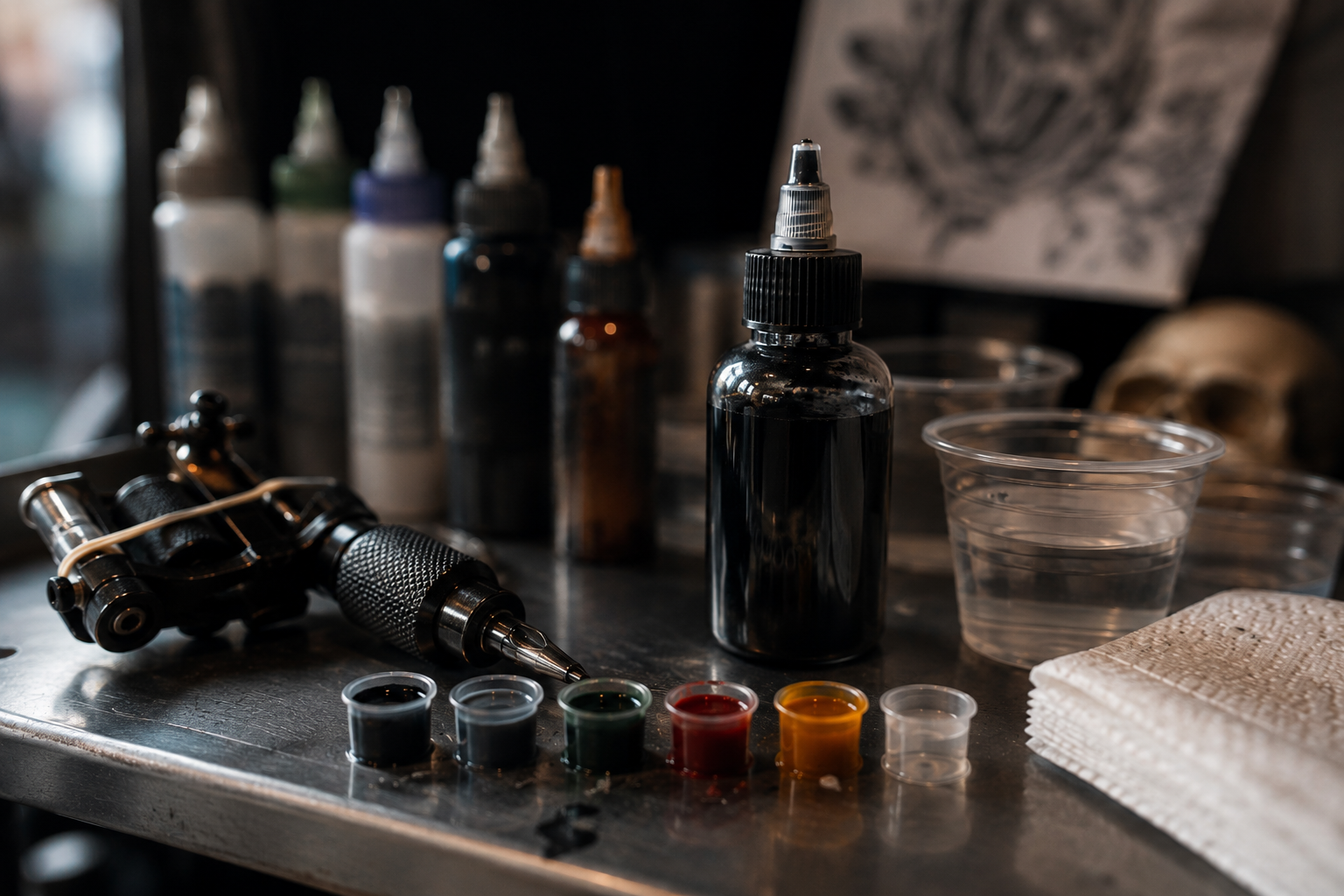
The little bottles sitting on an artist's workstation today are the result of decades of refinement. Manufacturers now spend enormous amounts of time improving consistency, reducing contaminants, tightening quality control, and meeting increasingly demanding regulations.
Artists ask tougher questions than they did thirty years ago because their clients do, too. They want pigments that heal predictably, remain vibrant, and come from manufacturers who take production as seriously as the artists take their craft.
The average client never sees that side of tattooing. They don't see microbiologists, production engineers, sterilization protocols, or laboratories testing pigments before they ever reach a tattoo shop. It's funny when you think about it. Tattooing spent decades trying to convince the public it was an art form, while everyone was arguing about whether tattoos belonged in the workplace, the industry quietly transformed itself behind the scenes. Better machines, needles, sterilization. Education, and yes… better ink.
Some of the biggest improvements aren't even visible. Today's artists have access to high-quality vegan inks that eliminate animal-derived ingredients, along with manufacturing processes that emphasize consistency and purity in ways earlier generations could only dream about. That doesn't mean every bottle is made from magical plants harvested under a full moon. Modern inks still rely heavily on advanced chemistry because chemistry is what keeps colors stable, vibrant, and reliable over time. The goal isn't to sound natural, it's to perform exceptionally well while meeting higher safety and quality standards. That's real progress.
Ironically, the better tattoo ink becomes, the less anyone notices. Nobody walks out of a shop saying, “Man, those pigments had incredible batch consistency.” They walk out talking about the artist. And that's exactly how it should be.
The ink shouldn't steal the show; it should quietly help create something that lasts a lifetime.
That little glowing star on my arm still makes me laugh every time I accidentally wander under a black light. It's a reminder that tattooing has always been willing to experiment, sometimes getting it right, sometimes learning the hard way. That's how every craft evolves. The difference today is that artists have more knowledge, better tools, and products backed by far more research than the generations before them. Those quiet improvements may never go viral on social media, but they're part of the reason tattooing has never been stronger. At Inker, I love telling these stories because the biggest changes in this industry aren't always hanging on the wall. Sometimes they're sitting in a little bottle that most people never think twice about.