
Before Tattooing Became Respectable
Long Beach, Outlaw Roots, and the Artists Who Kept Tattooing Alive
I recently spent a past Friday walking through the Villain Arts Tattoo Festival in Long Beach surrounded by some great tattoo artists. Every aisle was packed. Families pushed strollers past tattoo booths, and artists stood proudly beside their portfolios while others wandered the convention floor trying to decide which one would leave the next permanent mark on their life. Watching all of it unfold, I couldn't stop thinking about another Long Beach. Not the one outside the convention center, but the one that existed decades before tattooing became respectable.
Long Beach wasn't always the city people think of today. Long before coffee shops, luxury apartments, breweries, and waterfront redevelopment, this was a working port that never really slept. Cargo ships came and went around the clock, Navy ships filled the harbor, and longshoremen worked brutal hours moving freight. The streets around the docks weren't designed for tourists, they existed for people who worked hard, drank hard, and never knew where the next job or the next voyage might take them.
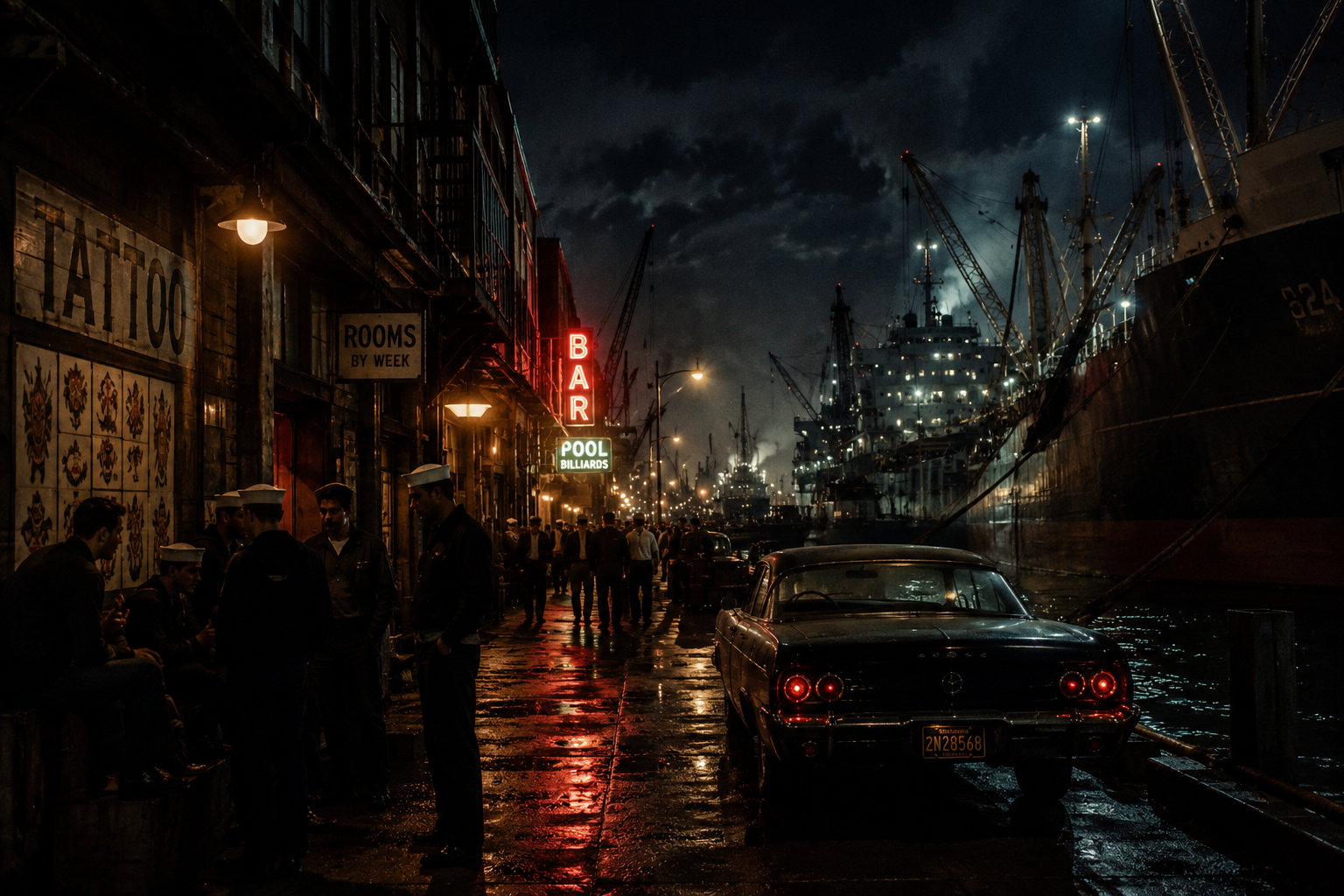
When the sun went down, certain parts of Long Beach took on an entirely different personality, with neon signs buzzing over smoky bars where ashtrays were always full, and somebody was always feeding another dollar into the jukebox. Pool halls stayed busy late into the night, and prostitutes worked corners that police officers knew by heart. Pawn shops bought yesterday's mistakes while liquor stores sold tomorrows. Sailors with fresh paychecks wandered from bar to bar looking for one last good night before their ship disappeared beyond the horizon again. The smell of diesel from the harbor mixed with cigarette smoke, ocean air, and cheap perfume, made it not glamorous by any means, but real!
Back then, if you walked into a tattoo shop you weren't stepping into an art gallery. Instead you would see flash covering the walls from floor to ceiling, with thick binders sitting on worn counters and the binder pages looking like they had been turned thousands of times. Then the buzz of coil machines blended with laughter from the bar next door and motorcycles rumbling past the front window.
Artists tattooing servicemen shipping out, bikers celebrating another cross-country ride, dockworkers spending part of a week's paycheck, and men who wanted something permanent to remember a place they might never see again. Nobody talked about building a personal brand or worried about social media engagement. Most artists were simply trying to make an honest living in neighborhoods that respectable society often pretended didn't exist.
Back then, tattoo artists weren't viewed as celebrities, or even viewed as artists. They were outsiders working in an outsider profession, serving clients who often lived just outside the boundaries of what society considered acceptable. Tattooing wasn't displayed proudly at backyard barbecues or family reunions. In many circles, it was still associated with sailors, bikers, ex-cons, carnival workers, and people who didn't fit neatly into the picture of middle America. The irony, of course, is that many of those same artists produced extraordinary work that would eventually influence generations of tattooers who came after them.
Standing inside the convention center, it was impossible not to appreciate how dramatically that world has changed. The outlaw mystique that once defined tattooing has gradually given way to professionalism without completely erasing its roots. Today's artists talk about skin science, color theory, sterile technique, machine engineering, and client experience, while drinking a matcha latte, but with the same passion earlier generations reserved for perfecting a clean line or pulling a smooth piece of traditional flash. The craft evolved, but it never forgot where it came from.
Every modern studio exists in the shadow of artists who kept tattooing alive when very few people respect what they did. They worked through decades when tattooing was misunderstood, heavily regulated, and often looked down upon. Without those artists, there wouldn't be sold-out tattoo conventions, international guest spots, million-follower tattoo accounts, or collectors flying across continents for a single appointment.
Walking through Villain Arts, I realized I wasn't just looking at the future of tattooing, I was looking at the reward earned by generations of artists who worked through the industry's roughest years.
Tattoo history isn't just found in museums or old photographs. It's still alive in cities like Long Beach, where every generation of artists has added another chapter to a story that's been unfolding for more than a century. The more artists I meet, the more convinced I become that understanding tattooing isn't just about appreciating great artwork. It's about understanding the people and places that shaped the profession into what it is today. At Inker, those stories deserve to be preserved because the future of tattooing makes a lot more sense when you understand the roads that artists traveled to get here.