
Did Tattooing Just Skip a Generation?
Why New Artists Are Learning Faster Than Ever
One of the unexpected perks of traveling around and interviewing tattoo artists is that I've developed a little game with myself. Before I ask how long someone has been tattooing, I'll spend a few minutes looking through their portfolio and make a mental guess. After talking to multiple artists, you start recognizing patterns. You can usually tell who's been grinding for twenty years, who's been in the industry for a decade, and who's still relatively new. At least that's what I thought. I've been wrong more times than I'd like to admit, and every wrong guess has pointed me toward the same conclusion.
I'll sit there looking at a sleeve that's beautifully composed, cleanly executed, and technically solid from top to bottom, convinced I'm talking to someone who's spent the better part of their adult life behind a tattoo machine. Then I'll casually ask how long they've been tattooing, expecting to hear fifteen years or maybe twenty, only to find out the answer is three years… sometimes four… occasionally even less. I'm not talking about artists who are simply promising for their experience level. I'm talking about artists producing work that would have earned respect in almost any shop not very long ago. After hearing that answer enough times, I stopped assuming I was just bad at guessing and started wondering whether the learning curve in tattooing has fundamentally changed.
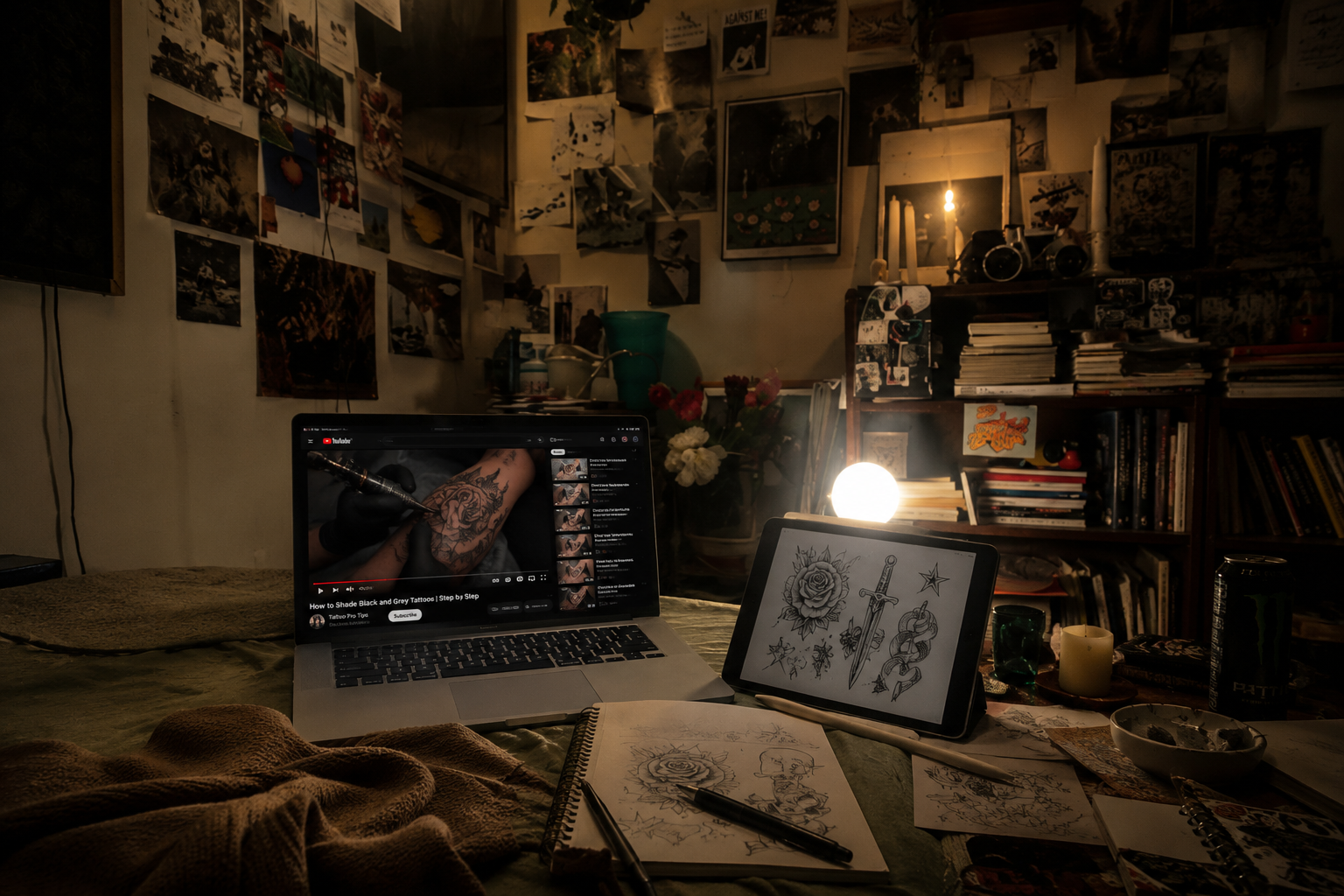
Years ago, the pace of learning was largely determined by where you landed your apprenticeship and who was willing to invest their time in teaching you. Most apprentices learned inside one shop, from one mentor, surrounded by one group of artists whose strengths and weaknesses naturally shaped the next generation. If realism wasn't your mentor's specialty, you probably weren't exposed to much realism. If no one in the shop excelled at Japanese work, lettering, or large-scale composition, those lessons often had to wait until much later in your career. Knowledge moved from artist to artist at a pace that now feels almost impossible to imagine because it was limited by geography, relationships, and access.
Today, an apprentice can spend an evening studying artists from five different countries without leaving the couch. YouTube alone has become an incredible educational resource where experienced tattoo artists openly discuss techniques, composition, machine setup, needle configurations, healing, and mistakes they've already made so someone else doesn't have to repeat them.
Social media has also changed the equation because artists are constantly posting healed tattoos, close-up details, and entire projects from start to finish, giving younger tattooers an opportunity to study work from some of the best artists in the world every single day. That kind of access simply didn't exist for previous generations, and I don't think we've fully appreciated how dramatically it accelerated the learning process.
None of that means experience has suddenly become optional because there are still lessons that only come from years of putting needle to skin. Every artist eventually discovers that real clients don't behave like practice skins, that every person's body presents different challenges, and that confidence only comes after solving hundreds of problems that no video could have prepared you for. Those lessons still have to be earned. The difference is that today's artists often arrive at those moments carrying years' worth of knowledge that previous generations had to discover through trial and error, allowing them to build on a much stronger foundation than apprentices had even twenty years ago.
The more artists I interview, the more convinced I become that we're witnessing one of the fastest evolutions tattooing has ever experienced. Great tattooing will always demand discipline, artistic vision, patience, and thousands of hours behind the tattoo machine, but access to knowledge has removed barriers that slowed every generation before this one. Maybe that's why I keep walking into interviews convinced I'm about to meet a twenty-year veteran, only to discover I'm talking to someone who hasn't even been tattooing long enough to remember what this industry looked like before knowledge became available to anyone willing to search for it.
Inker is seeing this evolution unfold in real time. Every week I'm introduced to artists at completely different stages of their careers, and one thing has become obvious: incredible talent no longer has to wait twenty years to deserve attention. There are artists only a few years into tattooing who are creating work that stops you in your tracks, but unless someone happens to walk into their shop or stumble across their social media, they may never get the recognition they've earned.
That's exactly why we're building Inker. We want it to become the place where great tattoo artists are discovered because of the quality of their work, not because they mastered an algorithm or happened to go viral. Whether you've been tattooing for three years or thirty, exceptional artists deserve an opportunity to be seen, and collectors deserve a better way to find them. If this new generation is redefining how fast talent can develop, we want to make sure the world doesn't miss it.