
First Edition
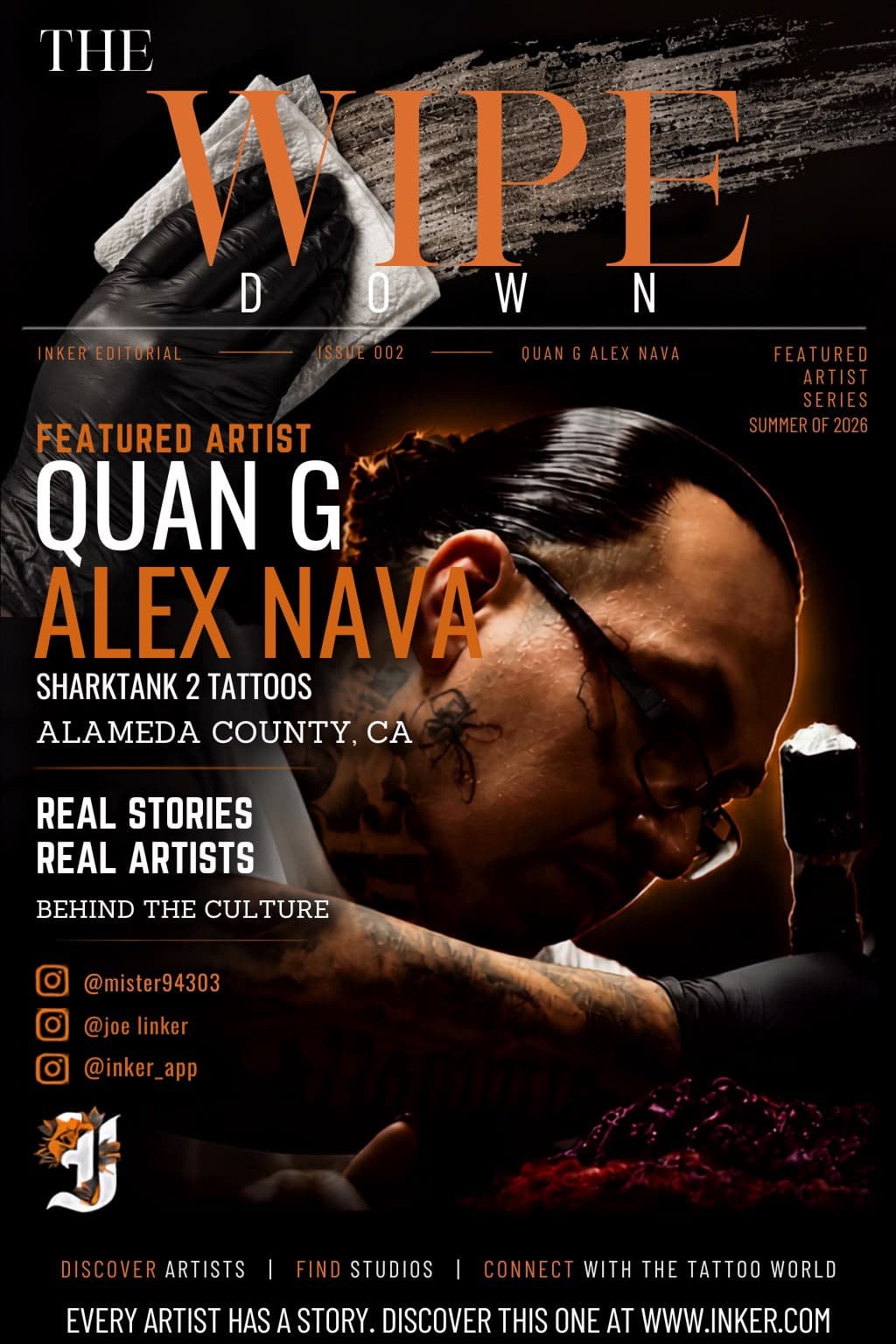
Quan G / Alex Nava
By Joe Gekko · August 26, 2026
Welcome to The Wipe Down
The Wipe Down is a collection of conversations with tattoo artists from across the industry, exploring the experiences, struggles, influences, victories, and defining moments that shaped the people behind the artwork. Every artist has a unique journey. Every journey leaves its mark.
Behind every tattoo is a person. Behind every person is a story worth preserving.
Welcome to The Wipe Down.
I've learned to trust my instincts because they've introduced me to some incredible people over the years. Every tattoo convention ends the same way for me. I come home with a pocket full of business cards, hundreds of photographs, pages of notes, and enough stories to keep me writing for months, but the difficult part isn't finding talented artists because they're everywhere. The difficult part is deciding whose story deserves another conversation. There simply aren't enough hours in the day to tell them all, so somewhere inside that stack of business cards instinct must take over. Every now and then one name refuses to leave my thoughts, and experience has taught me not to argue with that feeling because more often than not it's noticing something long before my brain figures out why.
That happened with Alex Nava, better known throughout the tattoo community as Quan G.
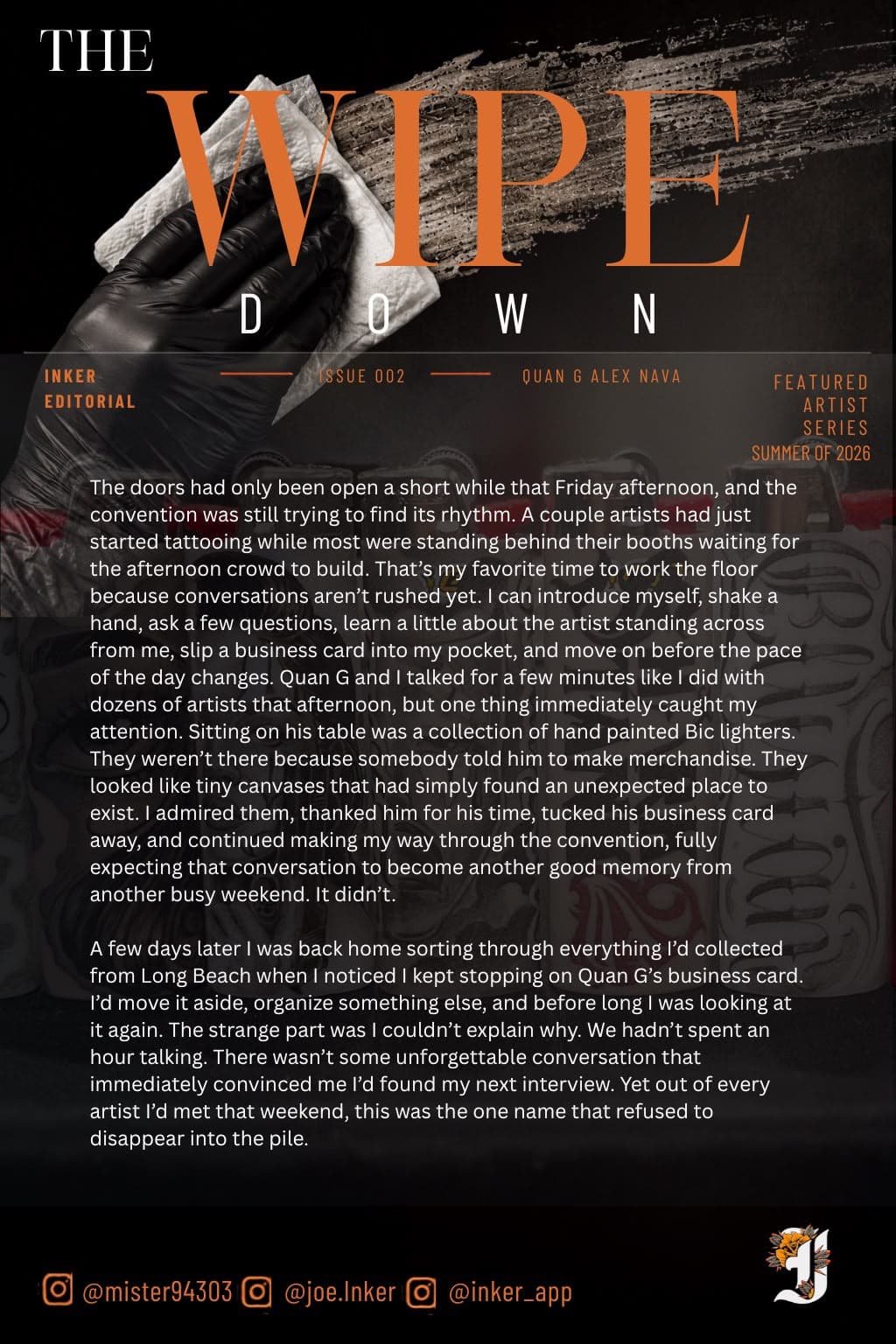
The doors had only been open a short while that Friday afternoon, and the convention was still trying to find its rhythm. A couple artists had just started tattooing while most were standing behind their booths waiting for the afternoon crowd to build. That's my favorite time to work the floor because conversations aren't rushed yet. I can introduce myself, shake a hand, ask a few questions, learn a little about the artist standing across from me, slip a business card into my pocket, and move on before the pace of the day changes. Quan G and I talked for a few minutes like I did with dozens of artists that afternoon, but one thing immediately caught my attention. Sitting on his table was a collection of hand painted Bic lighters. They weren't there because somebody told him to make merchandise. They looked like tiny canvases that had simply found an unexpected place to exist. I admired them, thanked him for his time, tucked his business card away, and continued making my way through the convention, fully expecting that conversation to become another good memory from another busy weekend. It didn't.
A few days later I was back home sorting through everything I'd collected from Long Beach when I noticed I kept stopping on Quan G's business card. I'd move it aside, organize something else, and before long I was looking at it again. The strange part was I couldn't explain why. We hadn't spent an hour talking. There wasn't some unforgettable conversation that immediately convinced me I'd found my next interview. Yet out of every artist I'd met that weekend, this was the one name that refused to disappear into the pile.
Eventually I stopped trying to explain it and sent him a message on Instagram. I told him something that probably sounded a little strange. Out of everyone I'd met at Long Beach, he was the one artist I couldn't stop thinking about.
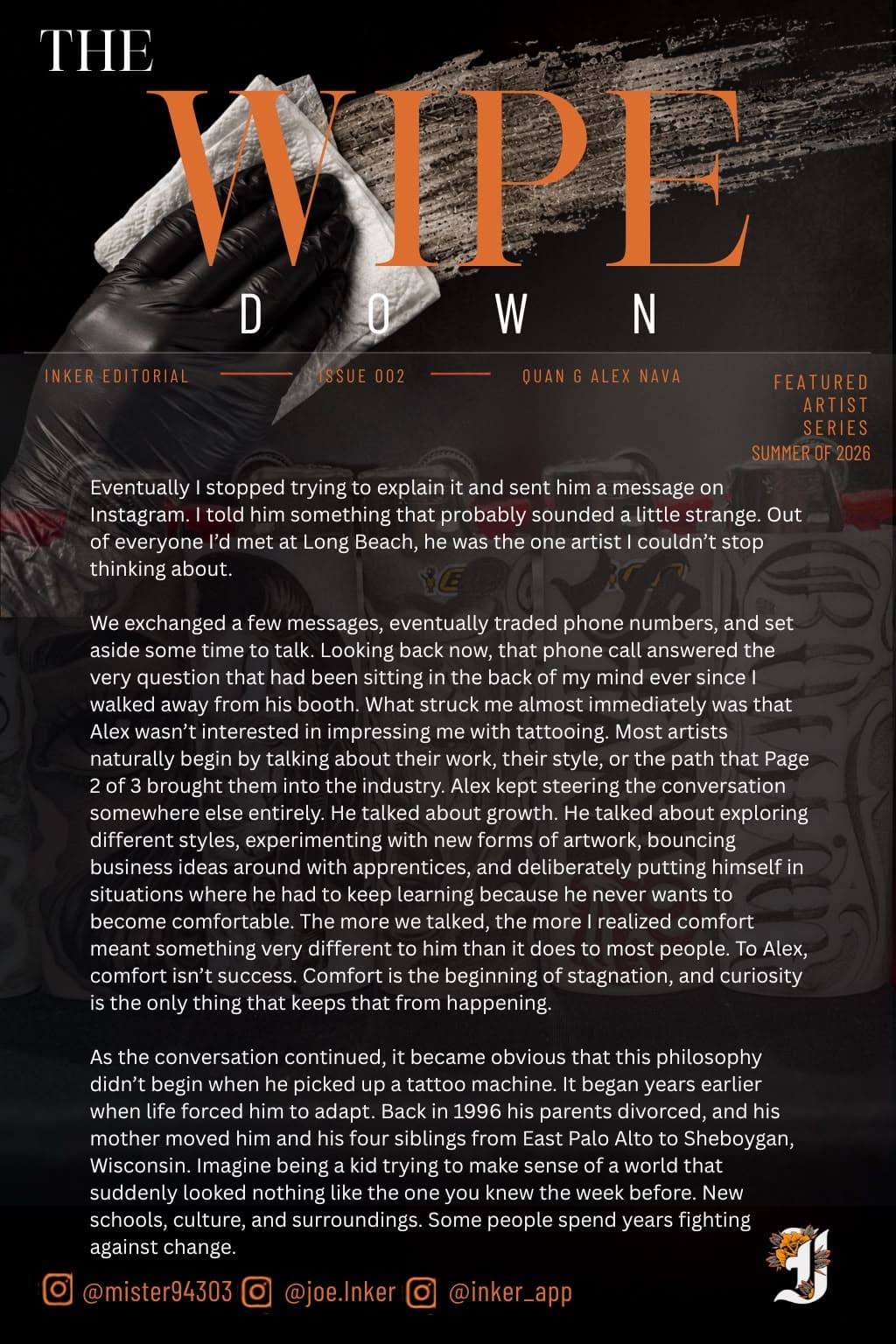
We exchanged a few messages, eventually traded phone numbers, and set aside some time to talk. Looking back now, that phone call answered the very question that had been sitting in the back of my mind ever since I walked away from his booth. What struck me almost immediately was that Alex wasn't interested in impressing me with tattooing. Most artists naturally begin by talking about their work, their style, or the path that brought them into the industry. Alex kept steering the conversation somewhere else entirely. He talked about growth. He talked about exploring different styles, experimenting with new forms of artwork, bouncing business ideas around with apprentices, and deliberately putting himself in situations where he had to keep learning because he never wants to become comfortable. The more we talked, the more I realized comfort meant something very different to him than it does to most people. To Alex, comfort isn't success. Comfort is the beginning of stagnation, and curiosity is the only thing that keeps that from happening.
As the conversation continued, it became obvious that this philosophy didn't begin when he picked up a tattoo machine. It began years earlier when life forced him to adapt. Back in 1996 his parents divorced, and his mother moved him and his four siblings from East Palo Alto to Sheboygan, Wisconsin. Imagine being a kid trying to make sense of a world that suddenly looked nothing like the one you knew the week before. New schools, culture, and surroundings. Some people spend years fighting against change.
Alex buried himself in art. Creativity became the one constant he could carry with him while everything else continued shifting around him, and although the family eventually returned to California, something important had already happened. Art was no longer something he enjoyed. It had become the way he processed the world.
Then the conversation drifted into a chapter of his life that had absolutely nothing to do with tattooing, and ironically it became the part that explained him better than anything else we discussed. Long before tattooing became his profession, Alex worked as a counselor for individuals with special needs. During those years he met a thirteen-year-old young man he affectionately nicknamed Bam Bam. Today Bam Bam is twenty-one, and despite building a demanding career in tattooing, Alex still spends three days every week with him. That relationship never disappeared when life became busier. It simply became another priority worth protecting, and somewhere during our conversation Alex shared something that completely reframed everything I'd been hearing. Bam Bam's parents trusted him enough to become the primary advocate for their son if something ever happened to them.
The weight of that decision is difficult to overstate. Parents spend their entire lives wondering who will protect their child after they're gone, and out of everyone they have known throughout their lives, they choose Alex. Nobody earns that kind of trust because they're talented or earns it because they're creative or successful. Trust like that is built quietly over years by showing up when you say you'll show up, keeping promises long after the excitement has faded, and living in a way where your actions become far more convincing than your words.
Looking back over everything we'd discussed, the pattern was impossible to ignore. His refusal to become comfortable, passion for mentoring apprentices, curiosity about new ideas, willingness to experiment with different forms of art, and my favorite, those damn little Bic lighters sitting on his convention table. None of those things existed independently, nope, they were all expressions of the same mindset.
Most people see a disposable lighter for exactly what it is. Alex sees a blank canvas. The more I reflected on our conversation, the more I realized those lighters weren't simply interesting artwork sitting on a table. They were introducing me to the artist long before he ever introduced himself. Some people have an unusual ability to recognize possibilities where everyone else sees ordinary objects, situations, or ordinary people. Whether it's a lighter waiting to become a piece of art, an apprentice searching for direction, or a young man who simply needs somebody willing to keep showing up year after year, Alex seems wired to look beyond what something is and become fascinated by what it could become.
When I went back through photographs of his portfolio after our interview, I wasn't studying tattoos anymore. I was looking for that same philosophy, and it was everywhere. Black and gray realism, lettering, graffiti influences, painted lighters, different mediums, and different styles. None of it felt random. It looked like the work of someone who refuses to allow routine to replace curiosity because growth has always mattered more than staying comfortable.
By the time I finished writing my notes, I finally understood why one ordinary business card refused to disappear into a pile with all the others. It wasn't because I'd met another talented tattoo artist. Talent fills convention halls every weekend across the country. What stayed with me was character, and that's exactly why The Wipe Down exists. The tattoo industry already does an incredible job celebrating finished tattoos. What it deserves just as much are opportunities to preserve the stories behind the people creating them because those stories become part of the industry's history.
That's also why Inker matters. Helping people discover great artists is important, and preserving the journeys that shaped those artists ensures that the culture itself doesn't disappear one generation at a time. Quan G's story began with an ordinary business card in my pocket, but it ended as a reminder that sometimes the most meaningful discoveries don't happen because you're searching for them. They happen because you were paying attention when your instincts quietly told you to look a little closer.
Joe Gekko, Inker