
International Issue 001
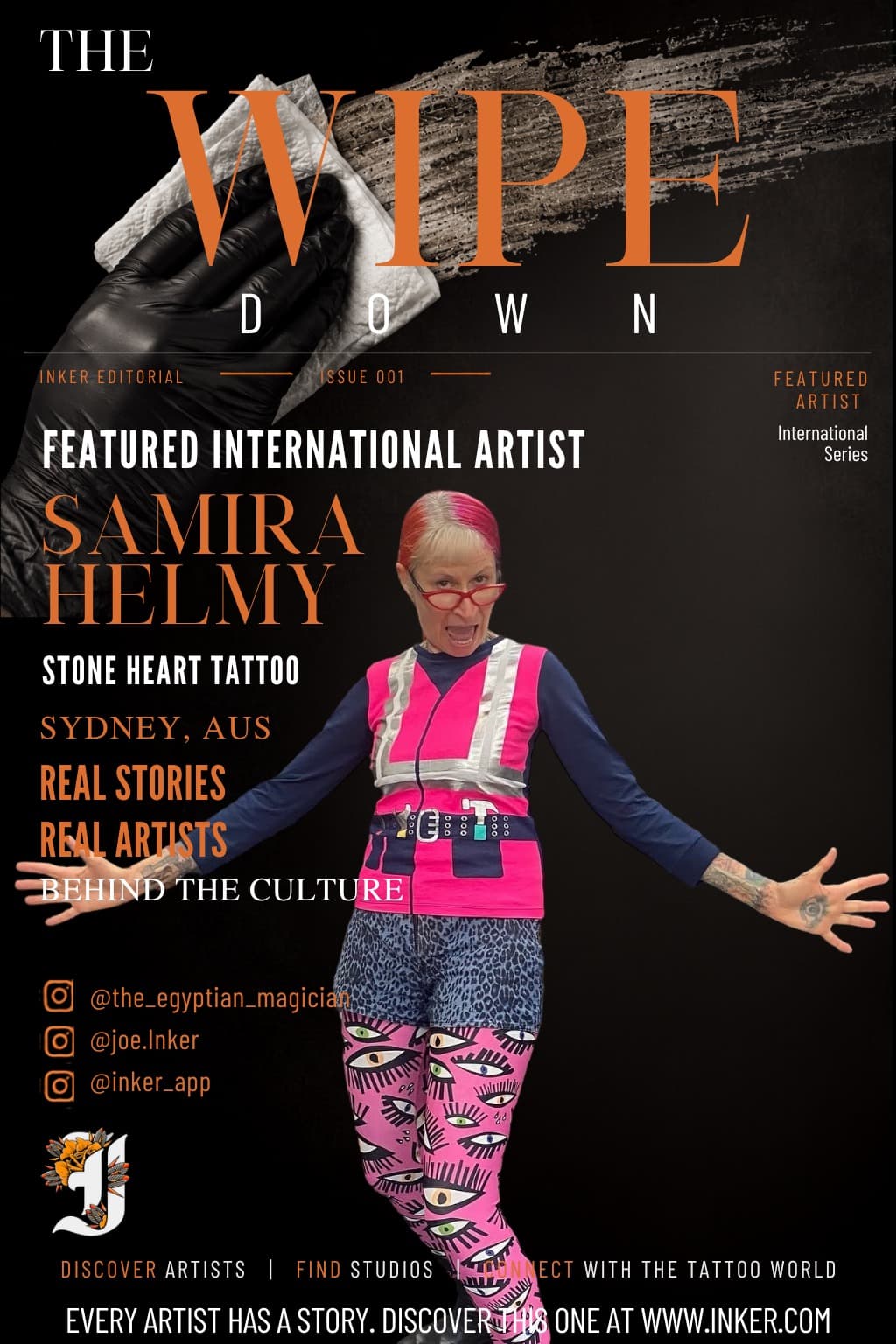
Samira Helmy
By Joe Gekko · September 8, 2026
The Wipe Down International
The Wipe Down is a collection of conversations with tattoo artists from across the industry, getting into their lives beyond what we normally see through their work. The conversations can go anywhere, and that’s the point, since knowing the artist changes the way you look at what they create. There’s always more there than the tattoo.
The Wipe Down International takes the same idea and removes the border, giving me a chance to get into the heads and lives of tattoo artists working in parts of the world I can’t always reach with a chair, a camera and a face-to-face conversation.
These interviews may happen across an ocean instead of across a tattoo station, but I’m still after the same thing: the person behind the work, the experiences that shaped them and all the strange little pieces of a human being that never make it onto an Instagram portfolio. Tattooing gets us introduced. Where the conversation goes after that is where this gets interesting.
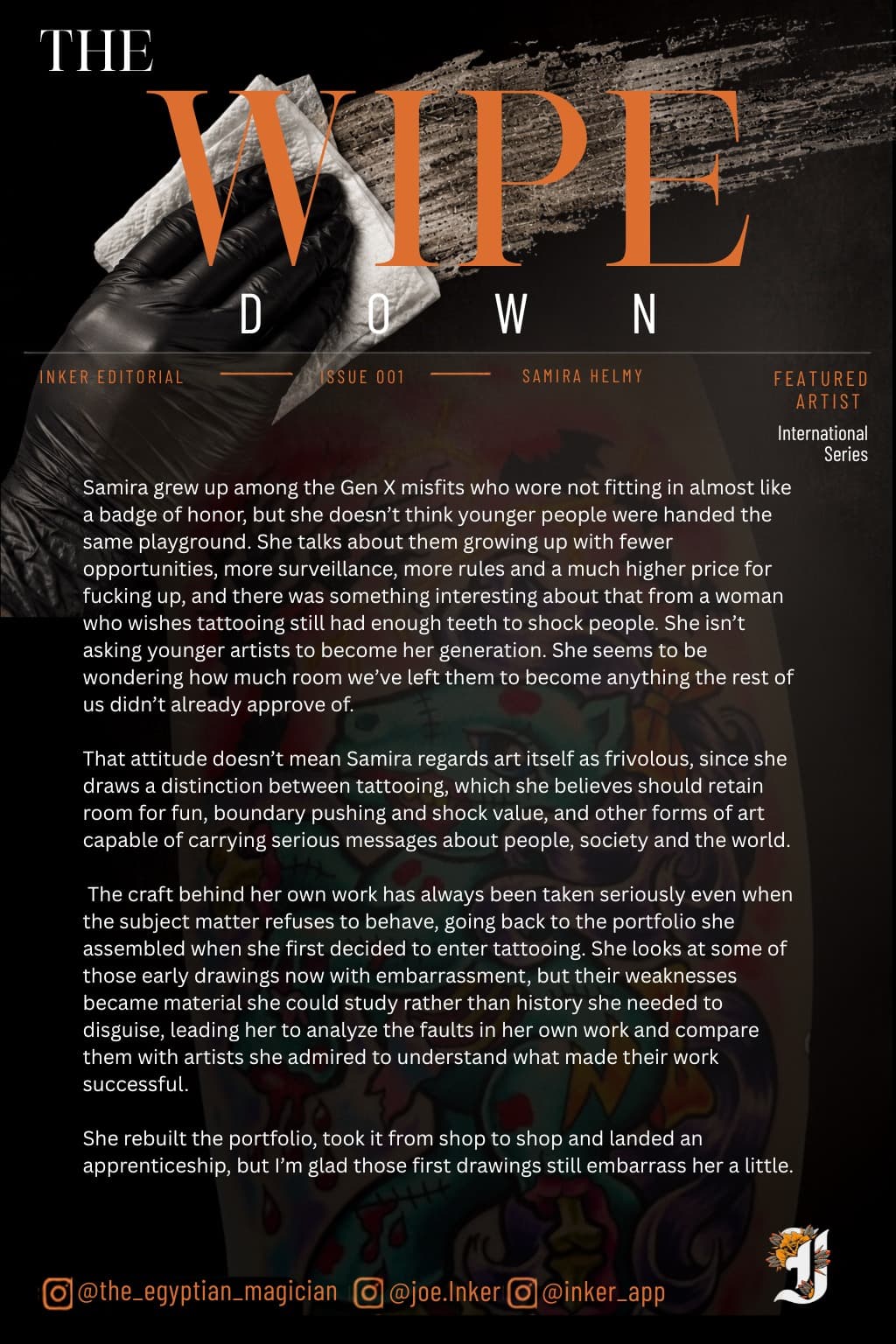
Imagine two matching tattoos somewhere in Australia depicting a zombie taco riding a zombie moose, commissioned by two friends whose private joke apparently required no explanation beyond the request itself, which was perfectly acceptable to Samira Helmy since the explanation was considerably less interesting to her than the opportunity to draw and tattoo the piece.
Known through her work as The Egyptian Magician, Samira has populated skin with monsters, pinups, animals with human habits, exposed brains, aliens, horror, bright colors, exaggerated expressions and combinations that sound increasingly ridiculous when described aloud yet become completely believable once she puts them together. Her artwork can be grotesque, funny, beautiful and deliberately absurd within the same composition, and there is little indication that she feels obligated to choose between any of those qualities when she can pile them together and see what happens. “I just like mashing things together that don’t really belong and seem ridiculous together,” she told me. “That’s how I get ideas.” The zombie taco and its undead moose transportation suddenly make perfect sense, or at least as much sense as they were ever supposed to make.
Samira grew up in the 1970s surrounded by exactly the kind of cultural ingredients capable of producing an imagination like hers, with classic science fiction, monsters and old television cartoons competing for attention alongside a home life that offered another source of creative disorder.
Her mother was a hippie with artist friends, putting Samira around experimental art and unconventional people at an age when those influences had plenty of room to settle in, and her later interests expanded into the lowbrow work of Robert Williams, Jimbo Phillips and Todd Schorr, along with pinup art and whatever else appealed to an appetite that never seems to have developed much respect for categories.
She doesn’t describe creativity as waiting around for inspiration to arrive with some grand announcement; she takes pieces that interest her, pushes them against other pieces that have no obvious reason to be there and works on the collision until she finds something worth drawing, which helps explain why the finished tattoos can feel familiar at first glance and completely peculiar a second later.
That visual identity wasn’t something Samira deliberately manufactured when she entered tattooing, and for a considerable part of her career she didn’t believe she had a recognizable style at all. Her apprenticeship began in a street shop where the education came from handling whatever work walked through the door, including plenty of realism, which she can do and doesn’t dislike but readily admits isn’t what she would choose if every appointment belonged entirely to her imagination.
The more unusual jobs were the ones that interested her, although she continued working without attaching a label to whatever was developing until a person at the shop pointed out that she already had a style. “Then I looked at my work with new eyes and found out that I did. Now I’m fully leaning into it.” There is something useful in the fact that another person saw Samira in the work before Samira did, particularly in an industry where developing a recognizable style is frequently discussed as though an artist should sit down early in a career and engineer one intentionally.
Hers appears to have accumulated through years of drawing what interested her, absorbing what surrounded her and allowing her sense of humor to contaminate the proceedings until the evidence became too obvious to miss.
Samira has little interest in whatever the tattoo industry currently considers cool or fashionable, and she has considerably stronger feelings about what she believes disappeared when tattooing became mainstream. “Tattooing has lost its shock value and I miss that,” she stated. She sees too much sameness now, too many artists looking at what everybody else is doing and clients who aren’t always willing to venture very far outside of it, which is exactly what makes an artist doing something completely different so appealing to her.
She isn’t interested in breaking rules out of ignorance either, since knowing what you’re doing gives you far more freedom to decide which rules deserve to stay and which ones are getting in the way. Learn them, understand what they do, experiment with them, ignore a few and break the right ones when the work calls for it, but being so afraid of doing anything wrong that you stop doing anything different is a trade Samira has no interest in making.
That determination to avoid predictability becomes more complicated when the same artist has to survive inside a marketplace increasingly dependent upon social media, a subject on which Samira requires very little encouragement before her opinion becomes unmistakable. “I absolutely HATE social media and the fact that I’m forced to market myself, making reels so I can attract clients. I’d much rather be drawing. Don’t get me started on what I think on this subject.” She remembers connections before social media as more genuine and less curated, and she dislikes the expectation that a working tattoo artist must divide creative energy between making tattoos and continuously manufacturing content to remain visible enough to obtain the next client.
Her statement that “being predictable is stifling to creativity” becomes particularly interesting inside that environment, where an artist whose imagination depends upon combining unexpected subjects also has to present that imagination through platforms where recognizable patterns and repeated content can become part of building an audience. Samira doesn’t pretend to enjoy that bargain, and there is no carefully polished speech about embracing digital marketing hiding behind the complaint; given the choice between producing another reel and drawing another ridiculous creature, she has already told us where she’d rather be.
Her actual drawing process is much less mystical than The Egyptian Magician name might suggest, beginning with fragments, scribbles and rough sketches that she describes as a kind of brainstorming session in which different possibilities are tested until one begins producing additional ideas.
Once the concept holds together, she sketches and refines it repeatedly until the final drawing emerges, although the character’s personality is being developed much earlier through a detailed consultation with the client. Samira asks questions intended to establish the emotion, attitude and overall feeling the character should carry, draws quick thumbnails in front of the client and throws ideas at them to establish how far the concept can be pushed before spending hours finishing something they never intended to wear. Once she understands the emotional direction, she tries to feel it herself as she draws, using that emotion to influence the linework, movement and exaggerated facial expressions, which explains why so many of her creatures appear to possess lives extending beyond the boundaries of the tattoo. I could throw a long list of descriptors at Samira’s characters here like every two-bit writer trying to convince you they’ve studied the artwork, but I’d rather put it this way: her characters look like they had lives before she drew them. You get the feeling they’ve been in places, done some shit and probably have a story Samira knows but hasn’t bothered telling the rest of us yet.
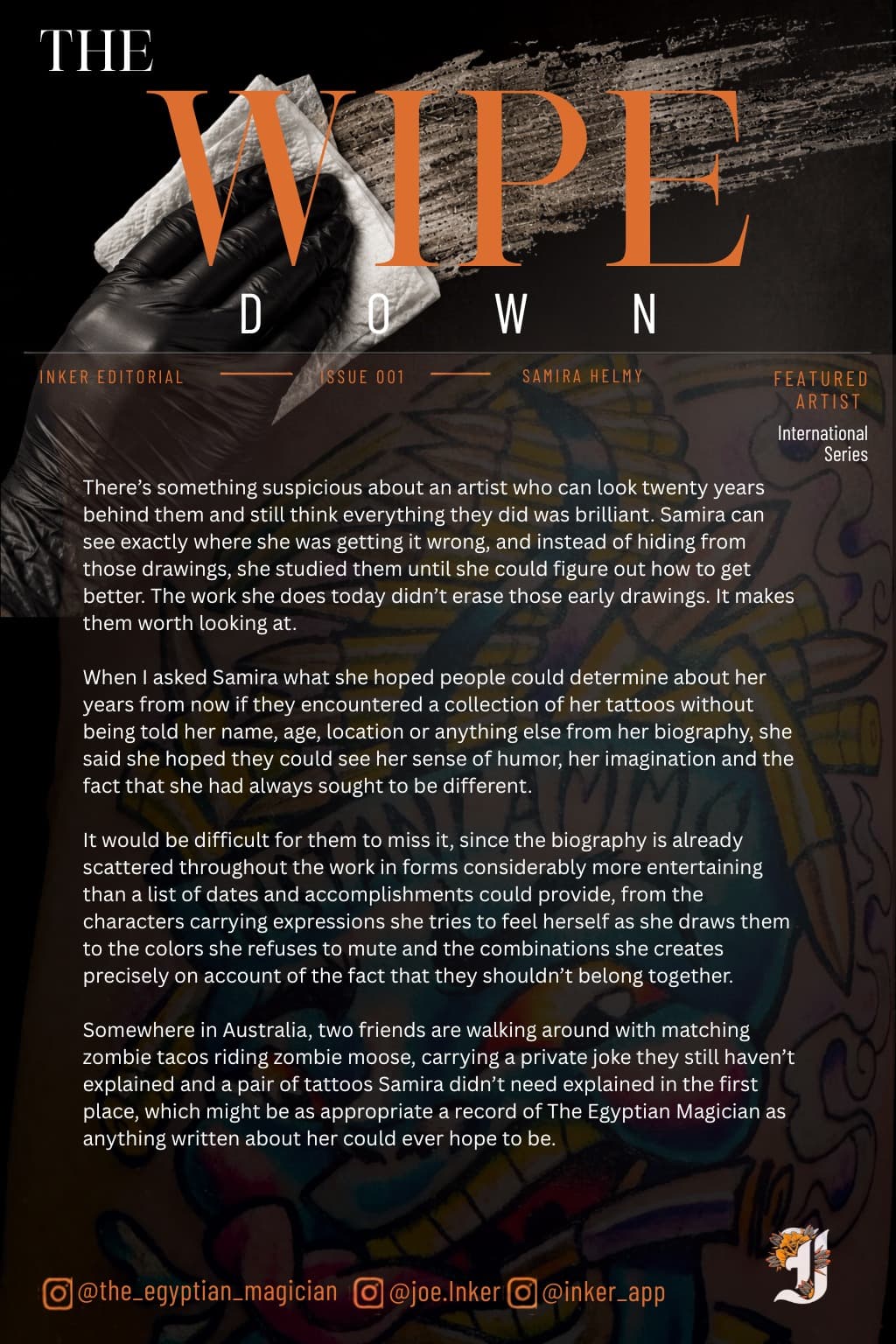
I’ve been smoking a cigar as I write this article, something about the smoke hanging around me helps shut everything else out, and looking through Samira’s work long enough has started turning this part into some kind of fucking spiritual experience. Yeah, I fucking said it. Stay with me here, since I’m already too far inside this thing to come back out and explain it politely. The smoke curls past the screen and suddenly Samira’s colors stop behaving like colors at all, purple starts feeling like a place you’ve been before but can’t remember, green has a pulse, red looks dangerous enough to touch, yellow comes screaming through from somewhere behind it all, and this ridiculous parade of monsters, pinups, exposed brains and creatures that shouldn’t exist starts feeling perfectly normal.
You’re not looking at the acid trip anymore, you’re standing inside the fucking thing with me, watching Samira turn the saturation up until reality gets embarrassed and leaves the room. Yet underneath all that apparent madness is control, since she plans her colors after the drawing is approved, deliberately putting contrasts against each other so they fight for your eyes without destroying the piece, experimenting when she needs to and refusing to soften anything with muted tones or pastels.
Take another look at her work after knowing that and the strange part isn’t how loud the colors are, it’s how naturally they belong inside a world that never existed until Samira decided it should.
Her willingness to push a concept does have a boundary, although it isn’t based on whether the finished tattoo might offend conventional taste. Samira states she will take an idea as far as the client permits but refuses racist, sexist and hate based tattoos, along with political imagery representing views she fundamentally opposes, and she has already turned away work falling into those categories despite the money attached to it.
Outside those limits, the available territory becomes considerably stranger, as demonstrated when I presented her with a hypothetical client with unlimited skin, unlimited money and absolutely no restrictions and asked what she would do with the opportunity.
Her answer included wild hybrid monsters, two headed pinups, space aliens, bin chickens and Ronald McDonald, with irreverent and mundane imagery mixed into serious subjects until the entire body became funny, ridiculous, full of movement and loaded with eye popping color. It isn’t difficult to determine which part of that proposal raises the greatest concern, although Ronald McDonald sharing anatomical real estate with two headed pinups and Australian bin chickens deserves consideration.
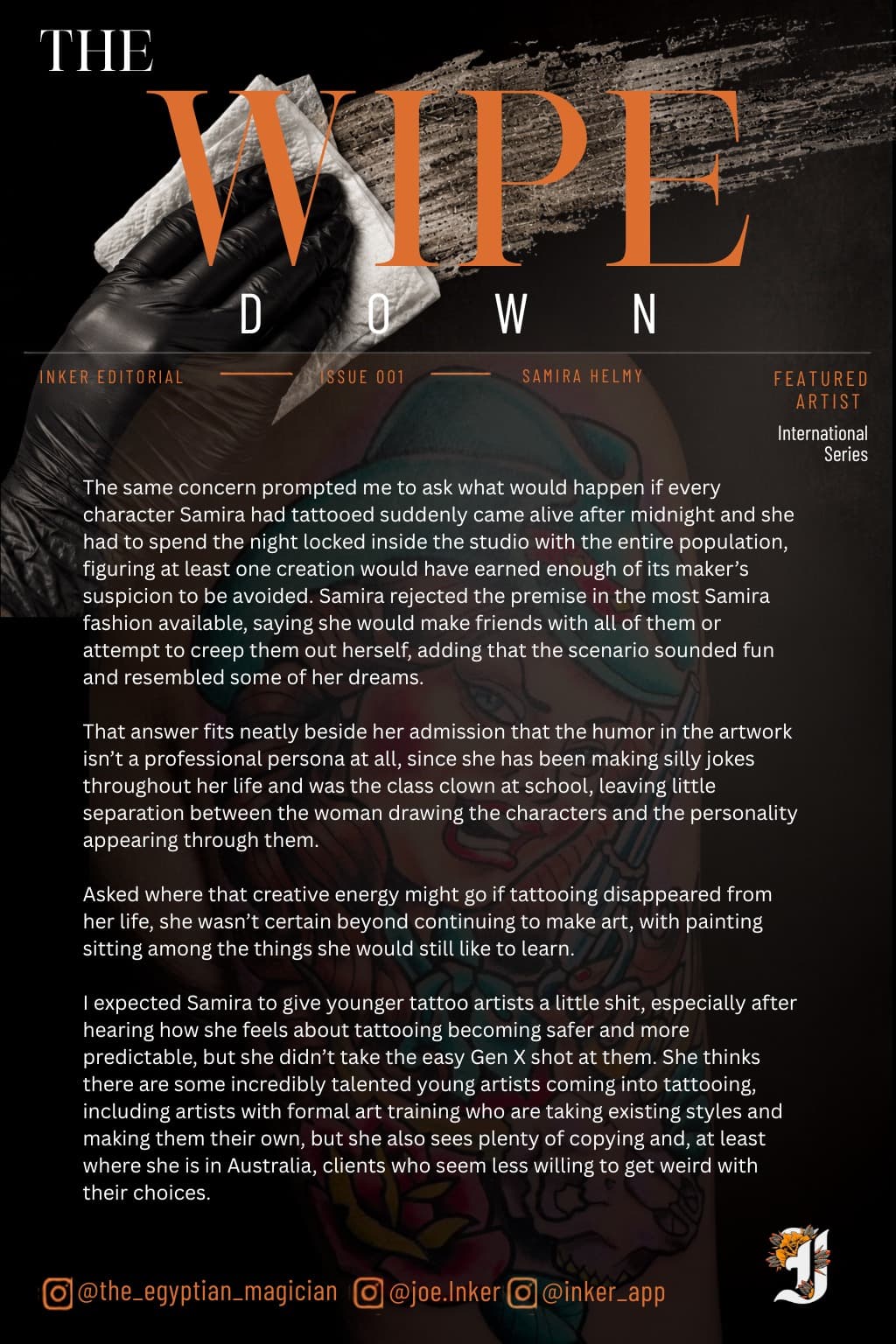
The same concern prompted me to ask what would happen if every character Samira had tattooed suddenly came alive after midnight and she had to spend the night locked inside the studio with the entire population, figuring at least one creation would have earned enough of its maker’s suspicion to be avoided. Samira rejected the premise in the most Samira fashion available, saying she would make friends with all of them or attempt to creep them out herself, adding that the scenario sounded fun and resembled some of her dreams.
That answer fits neatly beside her admission that the humor in the artwork isn’t a professional persona at all, since she has been making silly jokes throughout her life and was the class clown at school, leaving little separation between the woman drawing the characters and the personality appearing through them.
Asked where that creative energy might go if tattooing disappeared from her life, she wasn’t certain beyond continuing to make art, with painting sitting among the things she would still like to learn.
I expected Samira to give younger tattoo artists a little shit, especially after hearing how she feels about tattooing becoming safer and more predictable, but she didn’t take the easy Gen X shot at them. She thinks there are some incredibly talented young artists coming into tattooing, including artists with formal art training who are taking existing styles and making them their own, but she also sees plenty of copying and, at least where she is in Australia, clients who seem less willing to get weird with their choices.
Samira grew up among the Gen X misfits who wore not fitting in almost like a badge of honor, but she doesn’t think younger people were handed the same playground. She talks about them growing up with fewer opportunities, more surveillance, more rules and a much higher price for fucking up, and there was something interesting about that from a woman who wishes tattooing still had enough teeth to shock people. She isn’t asking younger artists to become her generation. She seems to be wondering how much room we’ve left them to become anything the rest of us didn’t already approve of.
That attitude doesn’t mean Samira regards art itself as frivolous, since she draws a distinction between tattooing, which she believes should retain room for fun, boundary pushing and shock value, and other forms of art capable of carrying serious messages about people, society and the world.
The craft behind her own work has always been taken seriously even when the subject matter refuses to behave, going back to the portfolio she assembled when she first decided to enter tattooing. She looks at some of those early drawings now with embarrassment, but their weaknesses became material she could study rather than history she needed to disguise, leading her to analyze the faults in her own work and compare them with artists she admired to understand what made their work successful.
She rebuilt the portfolio, took it from shop to shop and landed an apprenticeship, but I’m glad those first drawings still embarrass her a little.
There’s something suspicious about an artist who can look twenty years behind them and still think everything they did was brilliant. Samira can see exactly where she was getting it wrong, and instead of hiding from those drawings, she studied them until she could figure out how to get better. The work she does today didn’t erase those early drawings. It makes them worth looking at.
When I asked Samira what she hoped people could determine about her years from now if they encountered a collection of her tattoos without being told her name, age, location or anything else from her biography, she said she hoped they could see her sense of humor, her imagination and the fact that she had always sought to be different.
It would be difficult for them to miss it, since the biography is already scattered throughout the work in forms considerably more entertaining than a list of dates and accomplishments could provide, from the characters carrying expressions she tries to feel herself as she draws them to the colors she refuses to mute and the combinations she creates precisely on account of the fact that they shouldn’t belong together.
Somewhere in Australia, two friends are walking around with matching zombie tacos riding zombie moose, carrying a private joke they still haven’t explained and a pair of tattoos Samira didn’t need explained in the first place, which might be as appropriate a record of The Egyptian Magician as anything written about her could ever hope to be.
Before I close this out, I owe Samira a personal thank you. We’ve never met, we’re sitting on opposite sides of the world, and I sent her twenty questions that were designed to get considerably further inside her head than the usual artist interview. She gave it right back to me, including a few answers that sent this article places I wasn’t expecting when I started writing it. Samira, thank you for trusting me with your words, your work and a piece of that wonderfully fucked up imagination. I hope we get the chance to meet in person one day. I already know twenty questions weren’t enough.
Inker is currently focused on tattoo artists here in the United States, helping people discover their work without relying entirely on social media to decide who gets seen, and listening to Samira talk about how much she hates having to make reels to attract clients makes that mission feel a little less abstract.
The Wipe Down International gives me room to look beyond where Inker currently operates and introduce artists whose work deserves a closer look regardless of where they happen to live. Samira happened to be in Australia. Her work still stopped me. So I asked.
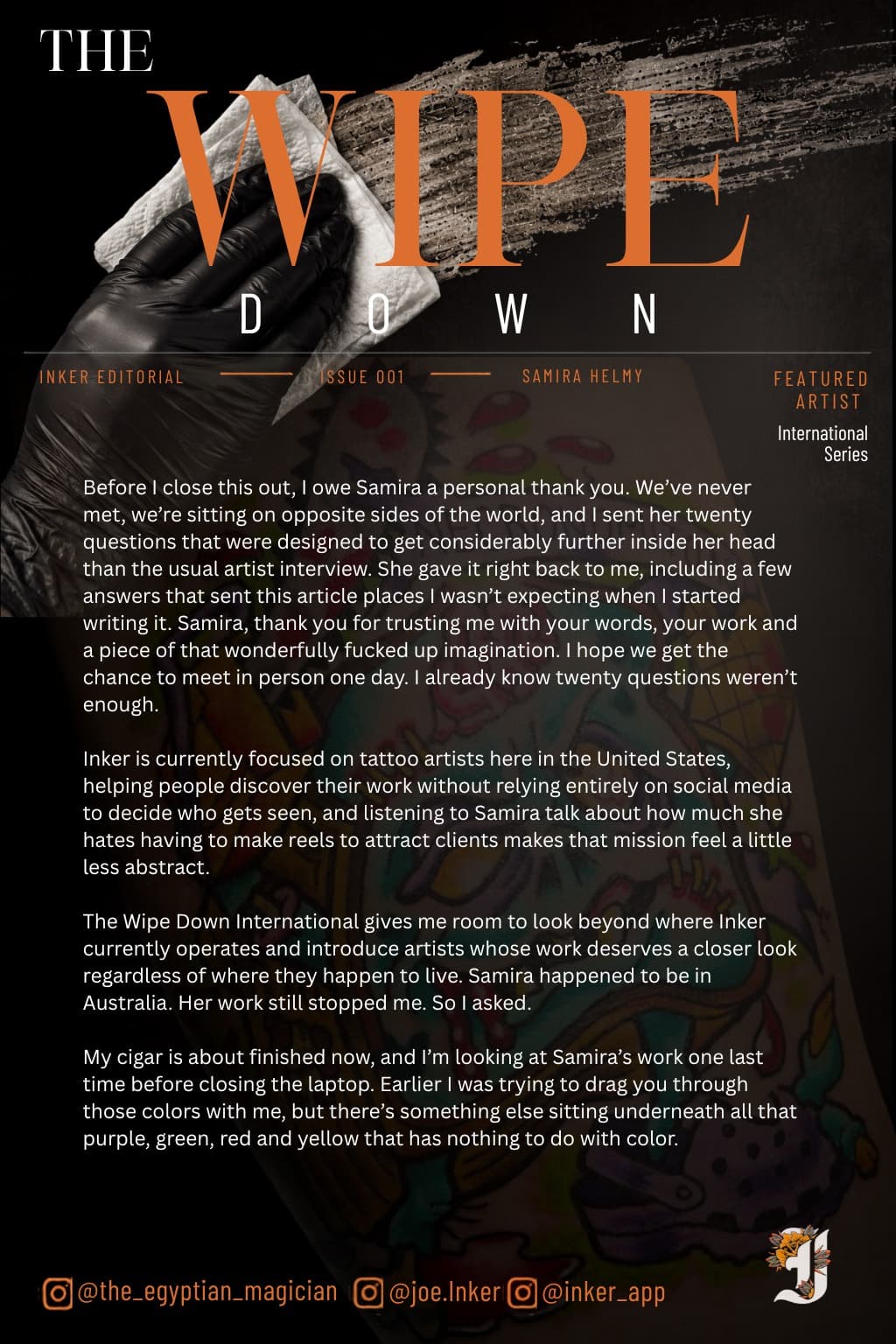
My cigar is about finished now, and I’m looking at Samira’s work one last time before closing the laptop. Earlier I was trying to drag you through those colors with me, but there’s something else sitting underneath all that purple, green, red and yellow that has nothing to do with color.
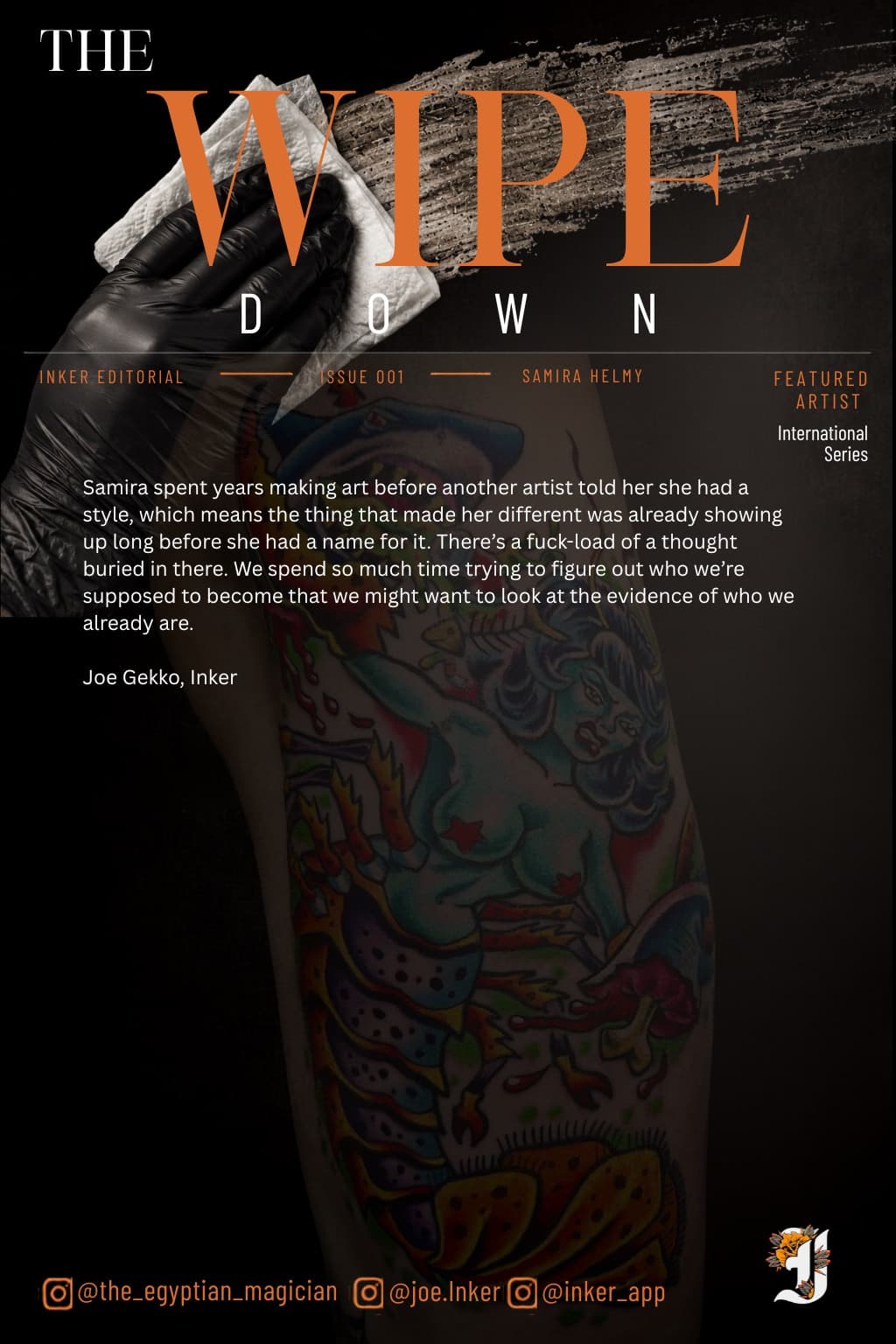
Samira spent years making art before another artist told her she had a style, which means the thing that made her different was already showing up long before she had a name for it. There’s a fuck-load of a thought buried in there. We spend so much time trying to figure out who we’re supposed to become that we might want to look at the evidence of who we already are.
Joe Gekko, Inker