
The Guy Ten Feet Away Does the Same Thing You Do
Tattoo Conventions, Artist Discovery, and the Culture Nobody Can Copy
A strange little city gets built inside a convention center and disappears a few days later, and no, this isn't another fucking Burning Man where everybody pretends being filthy is spiritual and goes home with sand up their pee hole. This city gets by without streets, buildings, zoning disputes or much of anything else normally required to establish civilization, since a rectangle of concrete, a black curtain and enough room for an artist to work apparently qualify as commercial real estate for the weekend, with another little country beginning about ten feet away under almost identical terms.
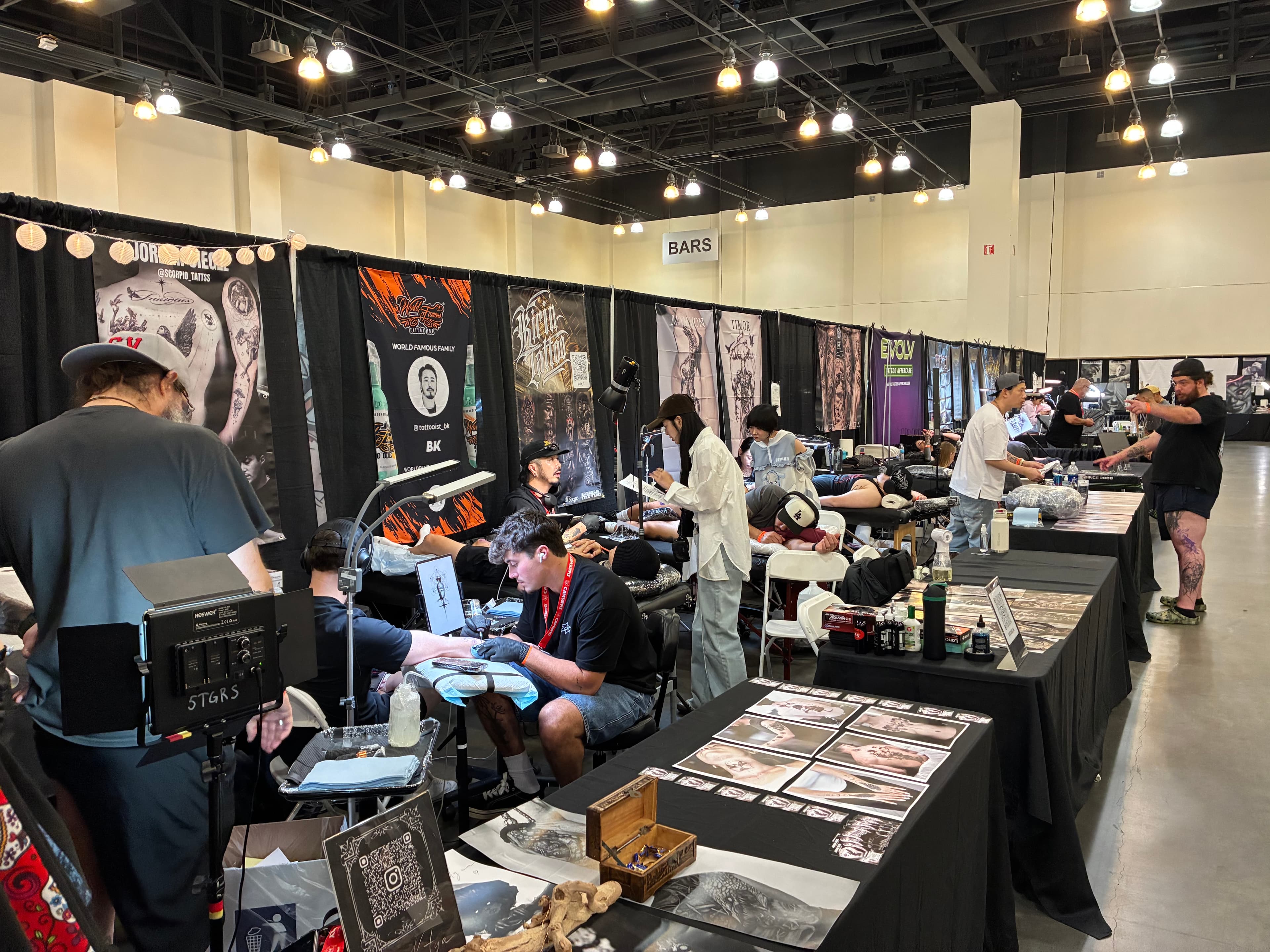
Keep going and there are tons of them, each with a name hanging against a curtain or divider of some sort, work displayed wherever it fits and enough equipment unpacked to conduct business a few feet from another artist. The curtain provides the illusion of separation without actually separating much of anything, which seems appropriate considering the collector standing in front of one artist can turn slightly to the left and become interested in another without filling out immigration paperwork or declaring anything at the border.
Other industries would consider this a terrible fucking business plan. A doughnut shop owner probably wouldn't be thrilled to learn ten competing doughnut shops were opening inside the same building with most of the walls removed, every kitchen visible and customers encouraged to inspect all of them before deciding where to eat, yet tattoo artists travel across the country and pay for the privilege of setting up under almost those exact conditions, except a disappointing doughnut can be replaced next weekend and a bad decision involving an entire forearm creates a slightly more complicated customer service problem.
The artist ten feet away can have 200,000 followers against 4,800 next door, a name recognized immediately against one that means absolutely nothing until the work gets a look, and none of it changes the physical arrangement once everybody occupies roughly the same amount of floor.
Instagram can make one artist look enormous by giving the account an entire screen, but a convention hall has the manners of a crowded elevator and keeps shoving everybody together until the numbers have to share space with the actual work.
That's when things get interesting, especially for people who enter convinced they already know what they like and leave with screenshots of artists they had never heard of a few hours earlier.
Black and grey might have been the original interest, but Japanese is sitting twenty feet away, engraving style blackwork is farther down, saturated color appears around another corner and some completely fucked combination that doesn't fit neatly into anything familiar can earn ten minutes of attention before anybody bothers figuring out what to call it.
A search bar isn't particularly helpful when the thing worth finding doesn't have a name inside the person searching for it yet, and that might explain part of the difference between discovering tattooing through an app and getting dropped into a building containing several hundred interpretations of it. Online discovery usually begins with enough information to ask for something; inside a show, the answer can arrive first and the question has to catch up.
That's probably where people who have never attended one misunderstand these events. There doesn't need to be a tattoo appointment waiting on the other side of admission, nor does an arm have to be covered before entry is permitted into the secret society. A person can know very little about tattooing and come out with a considerably more expensive education than expected, particularly after discovering that whatever style looked good online was only one neighborhood inside a city much larger than the app had been showing.
The follower counts are still there and social media obviously matters, but they behave differently once the artist with the smaller number is close enough to make a direct argument with the work. No algorithm has to grant additional distribution, or sponsored post needs to follow anybody around for a week and no little verification mark is required to establish that stopping in front of a portfolio was an acceptable use of time. An artist nobody planned to see can hijack attention with the incredibly sophisticated marketing technique of putting some really good shit where people can see it.
That primitive little transaction is worth paying attention to considering how complicated online discovery has become. Artists working in Southern California can post a tattoo before lunch, collect attention from Germany, Florida, Australia and another dozen places, finish the day with respectable engagement and remain unknown to a collector living ten miles from the shop who has been searching for exactly that kind of work. Everybody involved is connected to everybody else, except the two people close enough to actually conduct business together, which feels less like technological progress and more like building the world's most sophisticated GPS so it can recommend a business in Belgium when a service or product is needed in Anaheim, CA.
Now for the pitch………… Put those same people inside the convention center and a lot of expensive technology gets replaced by eyesight and walking distance.
That brings up Inker, and fuck it, the gloves can come off here since there is no reason to act shy about what we're building or pretend the copycat shit floating around the tattoo industry hasn't been seen. There are companies looking at pieces of what Inker is doing, producing their own version, buying a few ads and apparently deciding the race is on, which is perfectly fine if the assumption is that the product being copied is a directory with some profiles and a map.
That would be the easy part to copy. The harder part requires getting off the fucking computer!
Inker is free, but free isn't a schtick or bait attached to some master plan to squeeze everybody after enough profiles have accumulated. The objective has been taking shape in shops, conventions, during interviews and through conversations with artists and collectors who are considerably better at explaining what this industry needs than another marketing pitch deck from someone who's never had a tattoo.
We attend shows whenever possible, meet artists face to face, spend time in shops, conduct interviews and turn conversations into articles and other media that put more attention on good work without handing the artist an invoice afterward explaining which exposure package was accidentally purchased. That last part probably shouldn't sound unusual but judging by some of the responses that come back when contact is made, apparently it is.
The approach is usually pretty straightforward: Hey, I like your work and what you're projecting for the culture. Would you be down with me writing an article about you? Nothing particularly complicated there, yet the response can range from What does it cost? to What's the catch? followed by enough caution to make it obvious that plenty of artists have learned to expect the sales pitch hiding behind the compliment. Fair enough, since the same offer coming from a stranger would probably sound a little sketch to me too, especially in an industry where “exposure” has been beaten into a marketing word that frequently means somebody else is about to make money.
There isn't a catch on our end. Inker is doing its part for the culture by marketing artists without charging them for it, and that isn't charity or some temporary goodwill campaign designed to build a user base before the meter gets switched on. Helping good artists become more visible makes Inkermore useful to collectors, gives collectors better people to discover and adds something to the platform that can't be created by filling a database with names and photographs. Everybody involved benefits from the artist becoming easier to find and more interesting to learn about, so charging that artist for helping create the value never made much fucking sense in the first place.
Consider Inker an acquisition engine, which requires getting past the idea that building the application itself is some extraordinary technological accomplishment. Any dork still living in his parents' basement with enough time and access to modern development tools can build an app with artist profiles, upload portfolio feature, put pins on a map, add geographic search, sort by tattoo style and connect a booking button, and although all of those things need to work exceptionally well, they are still static pieces of technology that can be studied, copied and rebuilt by anybody determined enough to do it. That ain't shit compared with the problem sitting behind them.
The real value starts with what happens after a collector finds the artist, since location can establish who is close, style can narrow an enormous field and a portfolio can prove the work deserves attention, right?! but none of those things necessarily gives that artist enough identity to survive the next fifty profile views.
There is a history behind the work, influences that shaped it, personality attached to it and usually a pile of experiences that will never fit inside six photographs, which gives articles, interviews, Inkumentaries and other media a purpose far beyond filling space on a platform. They allow the artist to become more than another result returned by a search and give the collector more reasons to remember the person behind the work long after the scrolling stops.
Inker's objective isn't to sit behind computers waiting for artists to populate a directory so we can congratulate ourselves when the map fills up. Producing media around people worth knowing turns discovery into something far more valuable than another search result, particularly when the artist isn't being handed a marketing invoice for the exposure afterward.
Inker invests its own time and resources into introducing artists and their work to collectors, and when that exposure produces a customer lead, the artist receives the opportunity without having to buy it from us. The artist gains another potential client, the collector discovers an artist worth considering and Inker becomes more valuable every time that connection happens. We aren't asking artists to fund our acquisition engine; we're building the acquisition engine to bring customers to them.
Anybody can copy a profile page, filters, maps, search parameters or whatever the fuck feature looks interesting enough to reproduce, and there will always be another developer capable of building a prettier version of something already sitting on the screen. Culture is a much nastier thing to copy, since there is no code repository containing the relationships, conversations, editorial work and accumulated presence that comes from actually showing up and giving a shit about the people inside the industry.
The app is the easy part, and anybody impressed by the plumbing probably hasn't figured out what Inker is really about yet.
Five hundred bucks worth of advertising can make near anything look important for a few days, like a fucking participation trophy, man I hate those fucking things! And good for whoever wants to spend it, but tattoo shows have a pretty effective way of messing with perceived size once everybody gets packed into the same building. Giant following, tiny following, elaborate booth, folding table, twenty-foot banner, crooked sign somebody probably printed Thursday night, all of it gets thrown into the same room where a collector can walk right past the expensive shit and spend half an hour talking to an artist three booths down.
Tattoo culture has growers and showers too, which sounds juvenile as fuck until a monster online presence gets parked next to an artist with a fraction of the following and nobody standing in the aisle gives a shit which one looked bigger on the phone. Money can enlarge the presentation and advertising can enlarge the audience, but neither gets to climb inside the collector's head and force interest once the work is sitting there in front of everybody.
Inker doesn't need to win that game by pretending to have a bigger dick.
Getting artists customer leads without charging them, putting editorial and media behind people worth knowing, and continuing to stay up on the industry from the people actually inside it gives us plenty to work on without wasting time measuring ourselves against every new tattoo app that buys some ads.
Pieces of Inker are already popping up in other places wearing different logos, looking a little like the bastard kid nobody planned on introducing at Thanksgiving dinner, and it's hard not to get a laugh out of that. Steal a feature, move some shit around, buy a few ads and call the baby whatever seems appropriate; Inker has artists nobody knows about yet, stories that haven't been told and collectors trying to find work they can see perfectly well in their heads without having the slightest fucking clue what to type into a search bar.
Hundreds of tattoo artists sitting this close together also makes all the chest beating about size pretty funny, since a massive following, expensive booth and recognizable name can end up a few feet from a relatively unknown artist who proceeds to suck people across the aisle all weekend. Growers and showers apparently made it into tattooing too, which feels like an appropriate place to stop discussing size before somebody asks for measurements and this article crosses over from an “R” rating.
J Gekko
Staff Writer, Inker