
Tattoos Are Trashy
The Customer Standing at the Center of Tattoo Culture
I stopped her for three words printed across the front of her shirt: TATTOOS ARE TRASHY. She was standing in the middle of a tattoo convention with a drink in her hand, tattoos running across her arms, neck and legs, and behind her were rows of artists who had hauled their equipment, portfolios, and merchandise into that building hoping people like her would stop long enough to look. I asked if I could take her picture, she agreed, and I snapped it without knowing anything about her, including her name. The shirt was funny enough to earn a photograph, but looking at the picture now, the words across her chest are probably the least interesting part of what I caught.
Look at everything behind her in that picture and there's a pretty funny contradiction going on. The convention is packed with artists showing off what they can do, portfolios hanging everywhere, people working on tattoos and everybody trying to get another person to stop at their booth yet standing right in the middle of my picture is the reason any of it works.
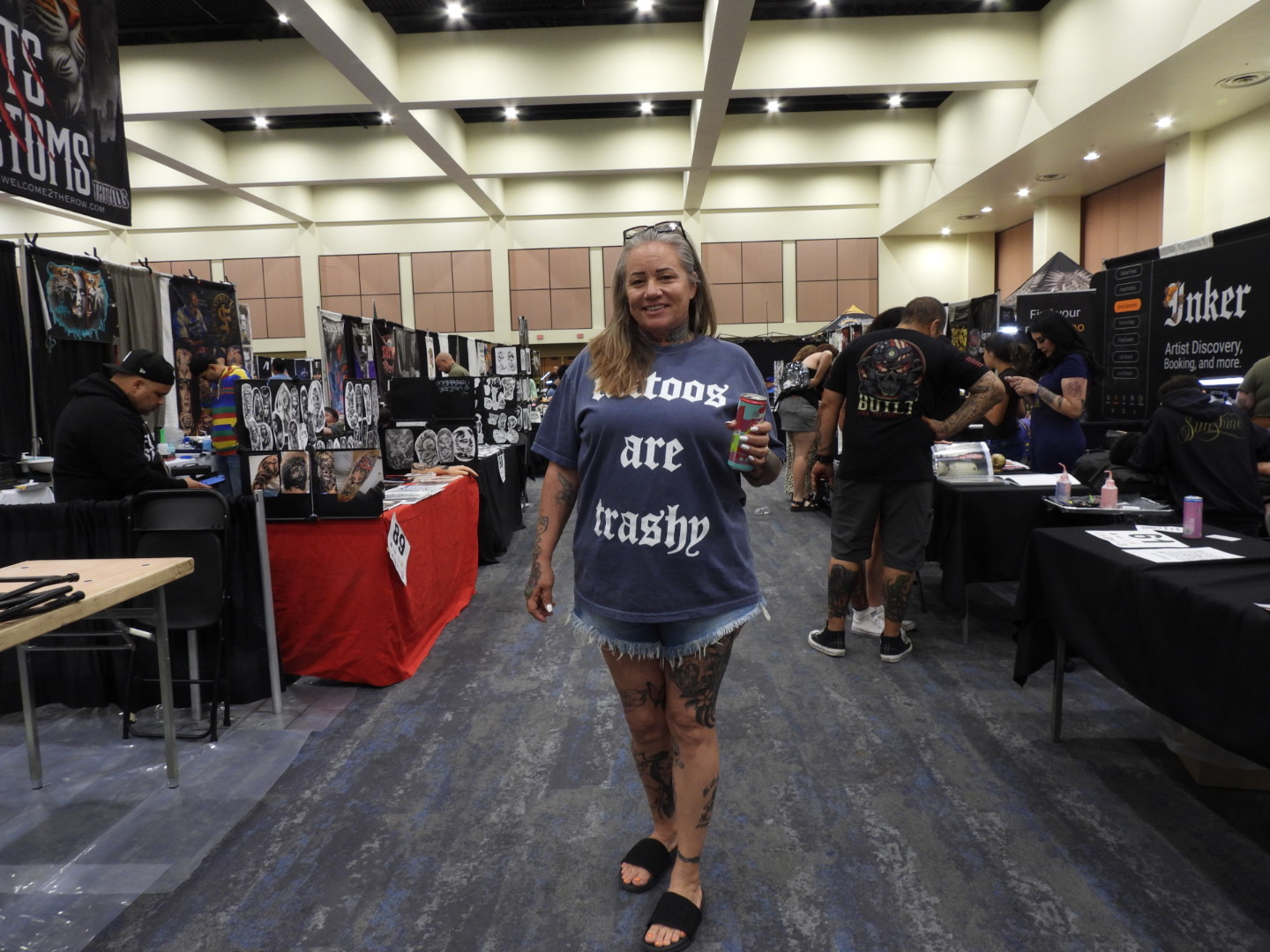
She's already covered in tattoos, so nobody needs to convince her to get one, and she came to a tattoo convention on her own, which puts her in a room full of artists who would probably love to figure out where she plans to put the next one. We spend so much time talking about who the artists are that we rarely talk about the people paying them, and this woman was walking around carrying years of purchases directly on her skin.
She also happens to resemble a consumer population much larger than the stereotype tattooing inherited. Pew Research Center surveyed 8,480 American adults in 2023 and found that 32 percent had at least one tattoo, with 22 percent reporting more than one, and women reported being tattooed at a higher rate than men, 38 percent compared with 27 percent. Among women ages 30 through 49, 53 percent reported having at least one tattoo, and 80 percent of Americans surveyed said society had become more accepting of tattooed people during the preceding two decades. The customer standing in my photograph isn't sitting at the edge of American culture anymore. There are millions of versions of her.
What got my attention were her tattoos and they tell you something about her purchasing behavior before she ever opens her wallet. Pew reported that 11 percent of American adults had exactly one tattoo and 22 percent had multiple tattoos, which means the larger group among tattooed respondents represented in those categories had already returned for more. Tattooing has a customer walking around with a permanent record of repeat purchases printed directly onto the product, except every additional purchase can involve another artist, another shop, another style and another city. The woman I photographed could walk ten feet in any direction inside that convention and encounter another person competing for whatever section of skin she decides comes next.
Her reasons for choosing that next tattoo are where ordinary consumer math starts getting strange. Pew found that 69 percent of tattooed Americans surveyed cited honoring or remembering a person or thing as a reason for at least one tattoo, 47 percent cited making a statement about what they believe, and 32 percent cited improving their personal appearance. Those aren't interchangeable reasons for buying an interchangeable product, and the person making the purchase has to decide who gets trusted to put something permanent on a body they will still be carrying long after the booth, convention and credit card charge are gone.
Put her in a convention and she can stand ten feet from an artist she never knew existed five minutes earlier and see the work for herself, which works pretty fucking well when you think about how people usually try to find tattoo artists. Take away the convention and that same artist could have a shop twenty miles from her house and remain completely invisible to her, his work buried somewhere on Instagram among thousands of other tattoos, her searching under words he never uses, neither of them having any reason to know the other exists even though she could be exactly the client he wants and he could be exactly the artist she's looking for. We've managed to put more tattoo work in front of people than at any other point in the history of tattooing and still leave them hunting around trying to figure out who the fuck made it and where they are.
You can find your third-grade teacher, an ex you haven't spoken to in twenty years and a taco at two in the morning but try finding the perfect tattoo artist thirty minutes from your house. Good fucking luck. If she knows what she wants, there's no good reason she should also need to know the artist's name, follow the right accounts, figure out which hashtags to search or wait for an algorithm to finally cough up the right person.
There could be an artist thirty minutes away doing exactly the work she wants and neither of them knows the other exists, which is where Inker comes in. Let her search for the tattoo she wants, show her the artists doing that work, tell her where they are and get out of the fucking way, way, right?! Finding the artist should be the easy part. Deciding where you're putting the tattoo is her problem.
There was also a piece of information missing from the photograph that makes everything I just wrote about her considerably more fun. The shirt didn't end with TATTOOS ARE TRASHY. I saw the rest when she turned around. Across the back it said: SO IS YOUR MOTHER!
Seven words split between the front and back of a shirt managed to carry decades of tattoo culture better than most explanations ever could. The insult gets the front, where everybody can see what tattooed people were called, and the answer waits on the back for anybody still interested in passing judgment. Pew found that 29 percent of adults without tattoos said seeing a tattoo on a person gave them a more negative impression, so the old attitude hasn't disappeared entirely. The woman in my photograph didn't appear particularly burdened by it. She was at a tattoo convention, covered in the thing the shirt was making fun of, carrying her drink through a building full of people who understood the joke before she ever had to explain it.
I never got her name, and at the time I didn't think I needed it. She was a woman at a tattoo convention wearing a funny shirt who let me take her picture, and that was pretty much the extent of our relationship. Now I wish I had asked, since the more I look at the photograph, the more I think about how much money, talent and effort was packed into that building trying to get the attention of people exactly like her. We spend plenty of time figuring out which artists everybody should know. I'm starting to think we better get a lot better at figuring out how the people paying for all this shit are supposed to find them.
If you're out there and this, is you or you know who she is, please have her contact me at jgekko@inker.com. We'd love to send you some Inker swag, and I'd really like to put a name to the woman who gave me an entire story with seven words and one photograph.
J Gekko
Staff Writer, Inker