
SHE DIDN’T ASK FOR A NEW CANVAS
Mastectomy Tattoos and the Artists Who Help Women See Their Bodies Differently
Last thing, or even a possible thought on your mind sitting across from a doctor discussing a mastectomy are artistic possibilities after the procedure. Women who’ve undergone breast surgery are working with artists to create elaborate designs across areas of their bodies that have already been through more than most of us would care to imagine.
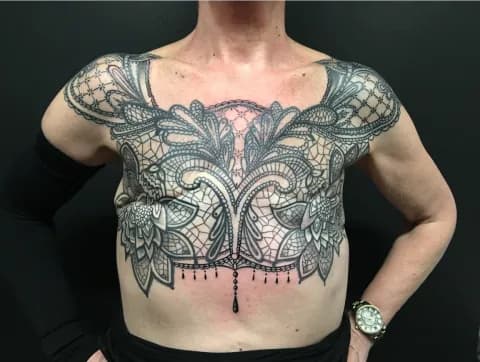
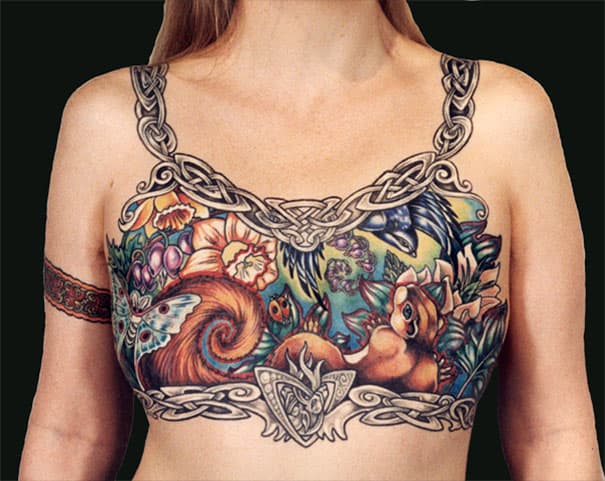
The two photographs accompanying this article, one features an intricate black-and-gray ornamental design stretching across the chest and shoulders, with delicate patterns that almost resemble an elaborate piece of lace clothing. The other is a colorful composition filled with flowers, animals, a few insects, and intertwined knotwork. Both demonstrate the kinds of elaborate designs tattoo artists can create across the chest, and both made me want to dig deeper into the subject of mastectomy tattoos.
I don’t know the personal histories behind these, but I do know that decorative tattoos after mastectomy have become an established option for women who want to change the appearance of surgical scars or create something personal on their bodies. And the more I researched this subject, the more respect I developed for the artists who choose to specialize in this work.
A mastectomy can involve removing one breast or both, and the options afterward can include reconstruction, an aesthetic flat closure, prosthetics, or leaving the chest as it is. Some women want their appearance restored as closely as possible to what it was before surgery. Others aren’t interested in another operation. And others discover that a tattoo offers a way to approach their appearance on their own terms.
Tattoo artists are accustomed to discussing designs, placement, and how much time a piece might require. Mastectomy tattooing comes with an entirely different set of considerations, including scar tissue, skin altered by radiation treatment, and loss of sensation. But there’s another consideration I had to give some serious thought to, and that’s the emotional significance of tattooing an area where surgery has already taken place. I’m of the opinion that, for some women, having an artist working on that part of their body again could be a real mind-fuck, especially if it brings back memories of everything they went through medically. And I don’t think that’s something an artist should overlook just because the scars have healed.
Scar tissue doesn’t accept ink the same way unaffected skin does. The texture can vary, the skin may be more delicate, and achieving an even result can require experience with surgical scars.
An artist might be talented at portraits and still lack the experience needed for this work. The woman seeking the tattoo needs more than an impressive Instagram portfolio. She needs an artist capable of explaining the technical limitations, discussing realistic expectations, and understanding when medical clearance is necessary. There’s no artistic accomplishment in pushing ahead with a tattoo when the skin isn’t ready for it.
Breast Cancer Now advises that scars must be fully healed before decorative tattooing, which takes around a year and ideally longer. The person should also have recovered from chemotherapy or radiotherapy, and their treatment team should be consulted before tattooing.
Tattooing can be used to recreate the appearance of nipples and areolas after breast surgery.
They’re called 3D nipple tattoos, but there’s no actual three-dimensional structure created by the ink. Artists use color, shading, and carefully placed details to produce the visual appearance of a nipple and areola. It’s a specialized form of tattooing, and some hospitals and reconstructive surgery practices work with trained tattoo professionals or medical providers who perform it.
The pro service provider’s objective will be under best efforts to match an existing nipple and create symmetry between reconstructed breasts or reproduce natural skin tones and textures.
THE ARTISTS WHO CHOOSE TO DO THIS WORK
I came across an organization called Personal Ink, better known as P.ink, which connects people who’ve undergone mastectomies with tattoo artists experienced in decorative scar coverage. Its P.ink Days program organizes events where participating artists create mastectomy tattoos for eligible recipients. The organization also maintains an assistance program intended to make this work accessible to more people.
The participating artists understand the tissue they’ll be working on, the size and placement of the artwork, and the limits of what can safely be accomplished. And the work doesn’t have to resemble the familiar pink ribbon that appears in so many breast cancer campaigns. Some women choose floral designs, ornamental patterns, or subjects that have absolutely nothing to do with cancer.
A woman may have spent years having her appointments, activities, and conversations dominated by medical matters. If she wants a tattoo of a colorful garden or an elaborate piece of decorative art, she shouldn’t have to incorporate a reminder of cancer into the design unless she chooses to. The tattoo belongs to her. So does the explanation, if she feels like giving one.
WHERE INKER FITS INTO THE CONVERSATION
Tattoo artists have specialties, and Inker gives people a place to discover artists and examine their work, but for a person considering a mastectomy tattoo, I’d encourage looking much further than a collection of posted pics. Ask whether the artist has experience with mastectomy scars, request examples of healed work, ask how consultations are handled, what the artist requires from the person’s medical team, and whether the design can accommodate the condition of the skin.
If an artist doesn’t work in this specialty, there’s nothing wrong with asking for a referral to one who does. I’d also like to see more experienced mastectomy tattoo artists represented in the broader tattoo community. Their work deserves recognition for its technical difficulty and for the care required to perform it responsibly. And collectors deserve a way to find those specialists without having to sort through hundreds of unrelated portfolios.
A DIFFERENT KIND OF FINISHED PIECE
Those two subject photographs. One artist approached the chest with elaborate ornamental patterns. The other created an entirely different visual arrangement. Both show how much artistic territory exists within this category of tattooing.
In closing, I’d like to interview women who’ve chosen this kind of tattooing, along with the artists who work with them. I want to know about their consultations, the designs that were rejected, the technical problems that had to be solved, and the things people considering these tattoos rarely get to hear about. I suspect those conversations would teach me more than a hundred beautifully staged photographs.
The women in those photographs don’t owe us their stories. But if they choose to share them, I intend to give them the attention they deserve.
J Gekko
Staff Writer, Inker