
Did I Just Endorse My Soul?
Oni Masks, Lost Meanings, and the Stories Ink Carries
I knew what they were as soon as I saw them. Two Oni masks were sitting on a shelf inside a tattoo shop, one red and one black, and I took the picture partly because they looked cool and because there's an Oni that has been sitting on my own arm for more than twenty years. I knew what mine was when I got it too, but knowing what an Oni is and knowing how a creature out of Japanese folklore made its way across an ocean and became familiar enough in American tattooing that I was wearing one more than two decades ago are two very different things.
Oni have been showing up in Japanese stories and art for centuries, usually recognizable by the horns, fangs and exaggerated faces that made them a natural fit for tattooing long before most Americans knew much about the culture behind the image. Calling them Japanese demons gets you into the neighborhood, but it leaves a lot sitting outside. Depending on the story and tradition, Oni have represented evil, punishment and danger, yet they have also been used as protective figures capable of driving away the very shit people feared, and that contradiction survived remarkably well once the imagery started traveling.
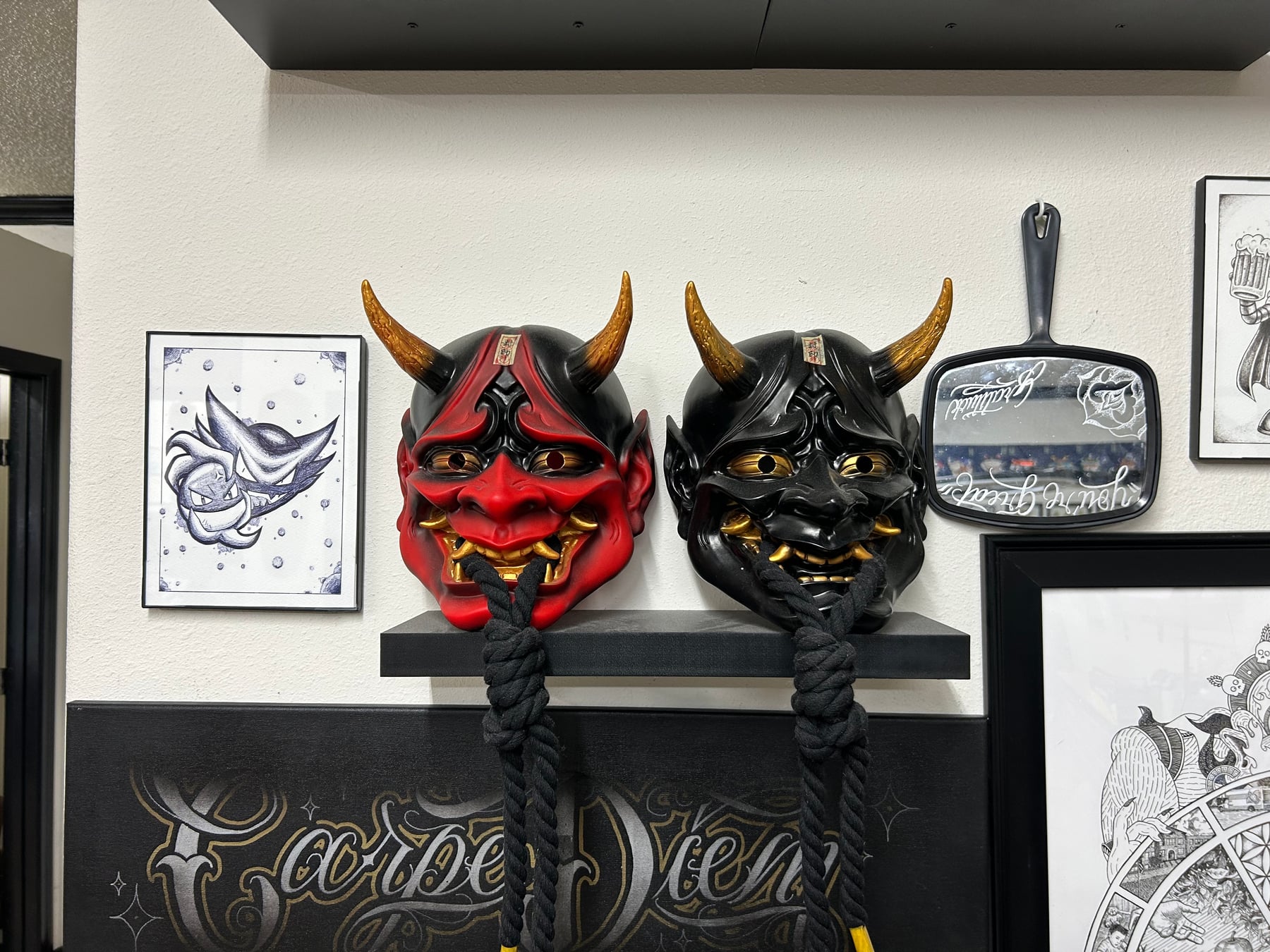
What I didn't know was when Americans started putting them on skin, how early they showed up in American tattoo shops, or when the Oni went from being part of the much larger Japanese tattoo tradition to an image an American collector could recognize, ask for and wear on its own. Mine tells me we can push that date back at least twenty years without opening a history book, but I have a feeling we can push it back a whole lot further once we start digging.
I'm not going to make this article into a predictable trip down Oni Lane. What I do want to get into is the fact that sometimes you get a piece tattooed on you because you like the way the flash looks, it fits where you want it, you think it's cool as shit, and you have absolutely no fucking idea what it means, what's behind it or whether you just endorsed your soul to some ancient demon who now technically owns your ass.
That probably wasn't much of a concern when you were looking at the flash. You liked it. The artist put it on you. Everybody went home happy. Twenty years later you can look at the same tattoo and start asking questions that never came up when you got it, and with an Oni those questions can take you back centuries before anybody had a tattoo machine. Even calling it a demon doesn't clean everything up, since Oni have been used to represent some seriously nasty shit in Japanese folklore and have also shown up in traditions connected to protection and driving evil away. Apparently even the demons have complicated résumés.
The colors can carry meaning too, along with the objects they're holding, and the stories surrounding them changed across different periods and parts of Japanese culture, which is a lot to inherit from a piece of flash you picked because the face looked badass. Add in the fact that Oni and Hannya get confused over here all the time and now there's another possibility: you may not only have no idea what your tattoo means, you might have spent the last fifteen years calling your tattoo by the wrong name.
None of this means every tattoo needs a research paper attached to it. People get tattooed for all kinds of reasons and “I liked the fucking picture” remains a perfectly respectable one. It does make looking behind some of these old images a lot more fun, though, especially when the explanation turns out to be nothing like the story that made its way across the counter at the tattoo shop.
Of course, finding out years later that your tattoo has a history you never knew about is probably the good version of this story. There have to be people walking around with considerably bigger surprises. Tattoo shops have spent decades putting all kinds of assorted weird shit onto people who weren't exactly stopping the appointment for a research break. Most of it probably worked out fine. But some guy out there has undoubtedly spent twenty years explaining the meaning of his tattoo with absolute confidence and been completely wrong every single time, lol.
Foreign lettering has always seemed like the easiest place for this to go completely off the rails. Getting a word tattooed in a language you cannot read requires an impressive amount of trust in the person holding the stencil, especially back when there wasn't a translation app sitting in everybody's pocket. You wanted strength, the flash book said strength, and your know-it-all buddy said it meant strength. The tattoo artist was pretty sure it meant strength too. Congratulations, there is now a Chinese character permanently attached to your body and three people involved in the decision couldn't read Chinese.
Symbols can be even worse since at least a mistranslated word has a right answer. A symbol can change meaning depending on where it came from, who was using it, what was placed around it and what happened to it after people in another country got ahold of it. Something chosen for protection can look threatening to everybody else, and a design that meant one thing a few hundred years ago can pick up entirely different baggage before it reaches a sheet of tattoo flash.
None of that makes the tattoo a mistake. It does mean the answer to “What does your tattoo mean?” could occasionally be, “Give me a few minutes, apparently I need to check.”
There's another person in this equation who might know a little more about the shit you're about to put on your body, and that's the tattoo artist. Not every artist is going to know the history behind every symbol that walks through the door, nor should they be expected to, but finding artists who actually work in the style you're interested in gives you a considerably better place to start than grabbing a picture off the internet and hoping everybody involved knows what they're looking at.
Guess what…... Here's the perfect spot to pitch Inker.
The largest tattoo artist directory shouldn't only make it easier to find a person with a tattoo machine; it can put collectors in front of artists they never knew existed and let the work tell them where to keep looking. Search through portfolios, get into styles you know nothing about, find the artist who has spent years working with the kind of imagery you're considering and ask a few questions before it becomes part of your anatomy.
There are artists buried all over this country with ridiculous amounts of knowledge sitting behind the work they do, and getting those artists in front of the people looking for them is a much bigger deal than another list of tattoo shops sorted by distance.
Get Discovered works in both directions. Artists need to be discovered by collectors, but collectors should be discovering artists, styles, imagery and ideas they didn't know existed before they opened Inker.
You might go in looking for an Oni and come out wanting something completely different after seeing what an artist can do with the idea, which is considerably cheaper than discovering twenty years later that the tattoo on your arm has an entire backstory nobody bothered to mention.
Or fuck it, pick the flash because it looks cool.
Just ask what it means before you endorse your soul!
J Gekko
Staff Writer, Inker