
Death Has Never Looked So Good
La Catrina, Mexican Heritage, and the Artists Behind the Imagery
When I saw these two, I had to take their pic. There was absolutely no way I was letting them get away without a photograph of what I was looking at. Between that enormous orange headdress, a dress covered in artwork that looked like it belonged on the side of a building somewhere in Mexico City, and the gentleman standing beside her wearing what appeared to be an entire art gallery, I had more questions than I had time to ask. And believe me, I had questions.
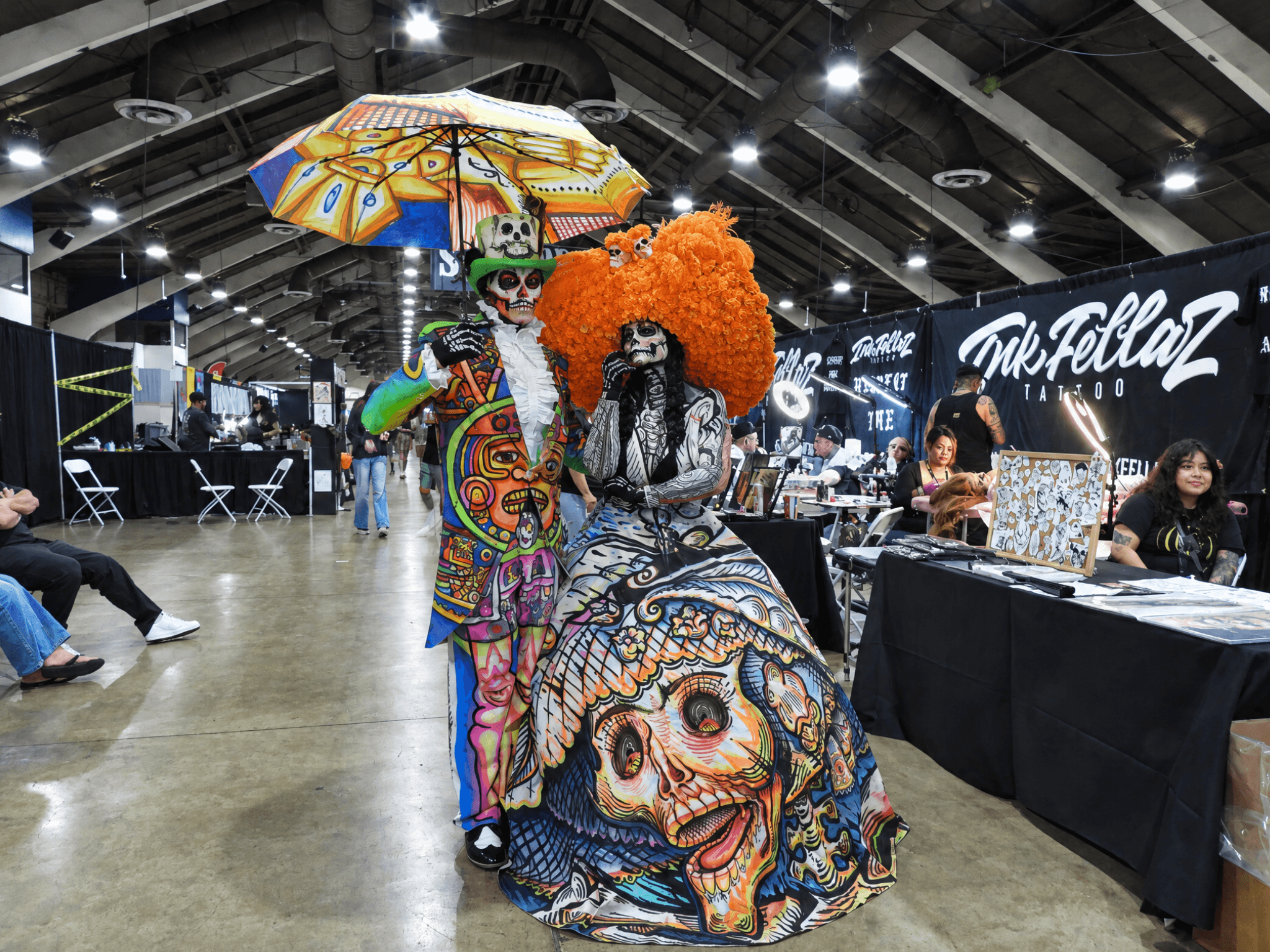
The woman is Maria Flores, better known as La Muerte Maria, and if you’re unfamiliar with her work, check out at her Instagram, @lamuertemaria. You’ll understand in a snap, “no pun intended,” why I stopped to take their photograph. Her page is filled with elaborate Catrina presentations, towering headdresses, intricate skeletal makeup and dresses that could probably have their own zip codes.
She’s a Chicana Catrina artist, model, makeup artist and SAG-AFTRA performer. Judging from the amount of work that goes into these creations, getting dressed for an appearance probably requires more preparation than most people put into their weddings. Seriously!
I didn’t get the gentleman’s name, which is a shame, considering he looked every bit as interesting as Ms. Flores. His suit was covered in brilliant colors and imagery, his face was painted like a skull, and he carried an umbrella that looked as though it had been borrowed from an Aztec king with particularly expensive taste. The two of them together made for a badass photograph. I might turn it into a postcard and send it to Ms. Flores, thanking her for their time.
Mexican culture has a fascinating relationship with death, particularly when you compare its Día de los Muertos traditions with the way death is commonly handled in American society.
Here, we tend to associate it with dark clothing, lowered voices, somber ceremonies and an understandable reluctance to discuss the inevitable. In Mexico, there’s a tradition of welcoming the dead back with flowers, music, food, and even a little humor. Día de los Muertos isn’t about pretending death is pleasant. It’s about remembering people whose lives still deserve a place among the living, even when those people are no longer physically here to enjoy the festivities.
Ms. Flores is portraying a character called La Catrina, and the woman she’s bringing to life has been around for more than a hundred years. The Genesis of this character started with a Mexican illustrator named José Guadalupe Posada, who had a pretty good sense of humor and wasn’t impressed with people pretending to be something they weren’t. Back in the early 1900s, there were Mexicans who wanted so badly to appear European and upper class that they were distancing themselves from their own Indigenous heritage. Posada decided to have a little fun at their expense and drew a skeleton wearing an enormous, fancy European hat. No body, no beautiful dress, nothing glamorous other than that ridiculous hat.
He called her La Calavera Garbancera, and the joke was aimed straight at people who thought dressing like European aristocrats made them better than everybody else. The more interesting part is that Posada could probably publish that same drawing today, change a few details, and still have plenty of material to work with. Think about how many people spend their lives trying to distance themselves from where they came from, changing the way they speak, disguising their backgrounds, dropping family names or pretending their parents weren’t working themselves to exhaustion so their children could have a better life.
We’ve managed to put a remarkable amount of technology into people’s hands, yet we haven’t figured out how to cure the embarrassment some people feel about their own beginnings.
And social media has given that scene an impressive upgrade. In Posada’s day, a fancy hat might have been enough to convince the neighbors you belonged to a higher social class. Today, you can rent a luxury car for an afternoon, photograph yourself in front of a house you don’t own, borrow an expensive watch and spend the evening convincing strangers that you’ve achieved a level of success your actual bank account might strongly disagree with. We’ve traded the European hat for a carefully manufactured Instagram account, and the underlying insecurity is still recognizable. Posada would have had a field day with this crowd, although he’d probably need a much larger sketchbook, LOL.
Posada died in 1913, but his skeleton wasn’t finished making appearances. Another Mexican artist named Diego Rivera, who was famous for painting enormous murals, decided she deserved a little more attention. In 1947, Rivera painted her into one of his murals, gave her an elegant full-length outfit and put Posada right beside her. The character became known as La Catrina, and what started as a cartoon making fun of people embarrassed by their heritage grew into a cultural figure that people now dress up as to celebrate that very heritage.
There’s a bit of revenge buried in that history, but nobody had to get hurt to accomplish it. The people Posada was making fun of wanted to hide where they came from, yet the character he created has become an internationally recognizable celebration of Mexican culture. The very identity those people considered embarrassing is now displayed in elaborate costumes, artwork, public celebrations and tattoos worn proudly on people’s bodies.
A century ago, people were trying to pass themselves off as European aristocrats. Today, artists like Ms. Flores are making a spectacle out of being unapologetically Mexican, and people are lining up to photograph them.
You have to appreciate the irony. Posada was making fun of people dressing up to look important, and more than a century later, people are putting extraordinary amounts of work into dressing up as his skeleton!
Now, back to Ms. Flores, who was standing there with that huge orange creation on her head and enough artwork on her dress to keep a tattoo shop busy for a month. She’s a Chicana artist from East Los Angeles who has taken a character that started out as a sarcastic drawing and turned her into something you can actually stand beside and have your picture taken with.
Posada supplied the original joke, Rivera gave the skeleton a wardrobe, and Ms. Flores has apparently decided that neither gentleman went far enough with the accessories.
Tattooing has always borrowed inspiration from the world around it, and Mexican art and culture have supplied enough material to cover a few million arms, backs and legs. Yet the people responsible for keeping these artistic traditions alive rarely receive the same attention as the images themselves. You’ll find thousands of Catrina tattoos online, but how many people know anything about the artists and cultural traditions behind them?
Inker changes how people discover tattoo artists by giving the people behind the artwork a larger presence, their work a place to be appreciated, and potential customers a better way to find them.
A person might arrive looking for a Catrina tattoo and leave having discovered an artist whose work speaks to an entirely different part of their life. That’s the kind of connection worth building a platform around. Posada needed a drawing, Rivera needed a wall, Ms. Flores needs considerably more closet space than the rest of us, and today’s tattoo artists deserve something better than having their entire careers depend on whether an algorithm happens to like what they posted Tuesday afternoon.
J Gekko
Staff Writer, Inker